Indonesian Palm Oil News (IPO News), Bali — Indonesia has significant installed capacity to produce Fuel Grade Ethanol (FGE) to support the development of biofuels. However, this capacity has yet to be fully utilized, as the bioethanol industry continues to face a major challenge: limited market absorption, or offtake.
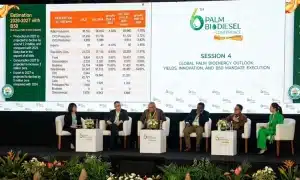
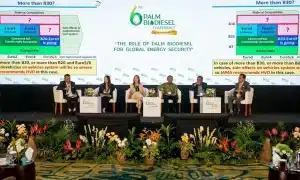
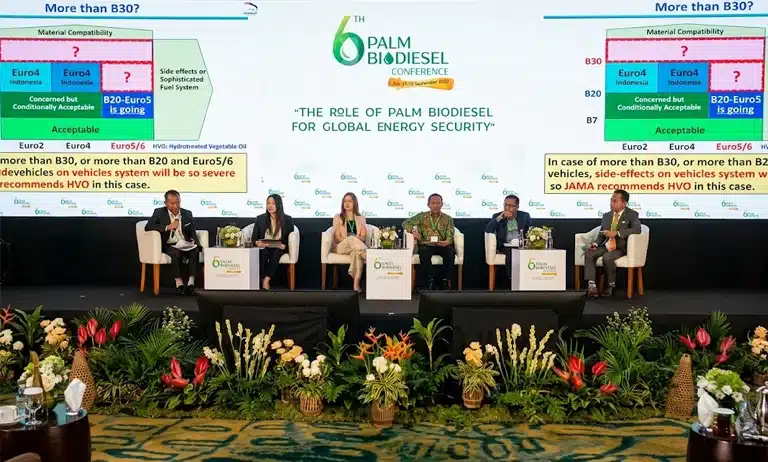
This was highlighted by Geovanni Garias Pradhana, Chairman of the Indonesian Association of Spirit and Ethanol Producers (APSENDO), during the 6th Palm Biodiesel Conference 2026 in Nusa Dua, Bali, on September 17, 2026. Speaking in a session titled “Accelerating the Energy Transition: A Multi-Sectoral Roadmap for Biofuels, Bioethanol, and Sustainable Aviation Fuel (SAF),” Geovanni revealed that Indonesia’s installed FGE capacity has reached approximately 70,500 kiloliters per year.
However, projected utilization in 2025 was only around 840 kiloliters, meaning that the utilization rate of the national FGE industry was only about 1.2%. According to Geovanni, this situation demonstrates that the main challenge facing Indonesia’s bioethanol industry is not simply production capability, but the creation of a market capable of absorbing bioethanol products on a sustainable basis.
Market Absorption Is the Main Challenge
Geovanni said that the development of bioethanol requires market certainty and a supportive ecosystem. Without reliable offtake arrangements, industry players may face difficulties in making investment decisions to expand production capacity.
For this reason, APSENDO is encouraging the Government to accelerate the implementation of the E5 mandate, which requires a 5% bioethanol blend in gasoline, while simultaneously developing a market ecosystem that can provide greater certainty for producers.
This issue will become increasingly important as bioethanol demand grows alongside the expansion of E5 implementation. From the feedstock side, Indonesia has considerable potential. National molasses production was estimated at around 1.7 million tonnes in 2025, while approximately 1.1 million tonnes was absorbed by existing industries.
This leaves more than 500,000 tonnes of molasses with potential to be directed toward fuel-grade ethanol production. APSENDO estimates that this volume could be converted into approximately 126,000–142,000 kiloliters of ethanol per year, potentially supporting around 7–8% of initial national E5 requirements.
However, these figures also demonstrate that the development of E5 will require a broader feedstock supply strategy. Molasses alone would not be sufficient to meet total demand if E5 were implemented nationwide.
APSENDO Calls for Greater Investment Certainty
To strengthen the bioethanol industry, APSENDO has presented several strategic recommendations to the Government. One of them is the updating of the bioethanol Market Index Price (HIP) formula. According to APSENDO, the formula needs to reflect current production and logistics costs more accurately in order to provide a more realistic basis for the industry’s economics.
APSENDO is also encouraging the establishment of long term offtake contracts with national fuel business entities. Such certainty is considered important in giving bioethanol producers greater confidence to invest and expand their production facilities.
Another important area is the development of storage and blending infrastructure. Transportation infrastructure, storage terminals and blending facilities need to be developed to ensure that bioethanol can be distributed efficiently.
With greater market certainty, an appropriate pricing mechanism, long term offtake agreements and adequate infrastructure, the industry would have a stronger foundation for increasing investment.
E5 and the Future of Indonesia’s Biofuel Industry
The development of bioethanol forms part of Indonesia’s broader agenda to expand the use of renewable energy in the transportation sector. While palm based biodiesel plays an important role in substituting diesel fuel, bioethanol has the potential to contribute to the substitution of part of gasoline consumption.
Together, these developments demonstrate that Indonesia’s biofuel strategy is expanding from a single fuel type toward a more diversified renewable energy ecosystem. For the bioethanol industry, the next challenge is therefore not simply to build production capacity, but to ensure that the resulting products have a clear and sustainable market.
Geovanni’s message at the 6th Palm Biodiesel Conference is particularly relevant in this context. Indonesia has feedstock potential and existing industrial capacity, but supportive policies are needed to connect production, pricing, infrastructure and market certainty.
With the acceleration of the E5 mandate and the development of a healthy market ecosystem, Indonesia’s bioethanol industry has the potential to expand further while contributing to energy diversification and reducing dependence on fossil fuels.
To subscribe or for more information, contact: Marketing Or Email
Need a research report? Please visit CDMI Consulting