
Indonesian Palm Oil News (IPO News), Bali — The Indonesian Government has reaffirmed its commitment to advancing palm-based biodiesel through the implementation of B50 and is also exploring the potential development of B60. However, increasing the biodiesel blending level requires more than production capacity. It also demands reliable feedstock availability, investment, infrastructure and a strong logistics and distribution network.
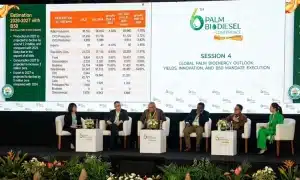
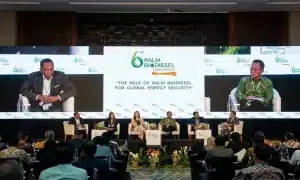
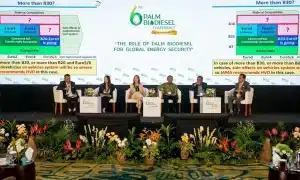
This was highlighted by Prof. Dr. Eng. Eniya Listiani Dewi, B.Eng., Director General of New, Renewable Energy and Energy Conservation (EBTKE) at the Ministry of Energy and Mineral Resources (ESDM), in her remarks delivered online at the 6th Palm Biodiesel Conference 2026, held in Nusa Dua, Bali, on Thursday, September 17, 2026.
According to Eniya, the Government remains committed to targeting the implementation of B50 in 2027. To achieve this target, she emphasized the importance of commitment from all stakeholders across the supply chain to ensure smooth and reliable B50 distribution.
“The B50 target remains set for 2027,” Eniya said in her remarks.
She stressed that the success of the program will depend heavily on supply readiness, as well as investment by biodiesel producers and logistics and transportation providers.
For this reason, the Government is providing preparation time to ensure that technical requirements and the overall supply chain are properly developed before Indonesia moves toward higher biodiesel blending levels.
HVO Considered as an Option Toward B60
Beyond B50, the Government is also beginning to focus on the possibility of implementing B60. Eniya explained that increasing the blend level to 60 percent presents technical challenges if the country relies solely on FAME, or Fatty Acid Methyl Ester.
One of the options being explored is the use of Hydrotreated Vegetable Oil (HVO) as part of a potential B60 formulation.
According to Eniya, the addition of approximately 10 percent HVO could be considered to complement the biodiesel blend if Indonesia moves beyond B50.
However, this option still requires further technical and economic assessment. One of the key considerations is the current price of HVO, which is estimated to be around 1.5 to two times the price of FAME. Therefore, the economic feasibility of such a blend needs to be carefully evaluated.
The development of B60, therefore, is not simply a matter of increasing the blending percentage. It requires comprehensive testing of fuel specifications, technology readiness and the industry’s ability to supply the required volume.
Supply Chain Readiness Is Critical
For Eniya, supply chain readiness is one of the key factors determining the success of Indonesia’s biodiesel program. Biodiesel producers, feedstock suppliers, processing facilities, logistics providers and distribution networks must all be prepared in a coordinated manner.
The Government is also encouraging adequate investment to ensure that the required biodiesel volumes can be produced and delivered to the market efficiently.
This becomes increasingly important as the mandatory blending level rises. Higher biodiesel mandates mean greater requirements for feedstock, production capacity, storage, transportation and distribution infrastructure.
The biodiesel program also has a broader economic dimension. The utilization of palm-based biofuel enables Indonesia to maximize its domestic resources while reducing dependence on imported fossil-based energy.
Beyond Biodiesel
In her presentation, Eniya also highlighted the development of other forms of biofuel. The Government is not only advancing biodiesel, but is also promoting bioethanol and Sustainable Aviation Fuel (SAF).
The development of various types of biofuels forms part of Indonesia’s broader effort to optimize domestic resources in meeting the country’s growing energy needs.
The Government has also recorded significant greenhouse gas emission reductions from the biodiesel program, with the reduction reaching more than 44.5 million tonnes of CO2.
For the palm oil industry, this development demonstrates that palm oil is no longer viewed solely as a food commodity and industrial raw material. It is also becoming increasingly important as a source of renewable fuel for Indonesia’s domestic energy system.
Indonesia Enters a New Phase of Palm-Based Energy Development
Eniya’s remarks at the conference highlight the increasingly complex stage of Indonesia’s biodiesel development.
B50 requires large-scale production and distribution readiness, while the potential move toward B60 will require more extensive assessments of FAME specifications, the possible use of HVO, feedstock availability and overall fuel economics.
Therefore, the success of higher blending mandates will not depend solely on government policy. Collaboration among the Government, biodiesel producers, the palm oil industry, energy companies, the automotive sector, logistics providers and other stakeholders will be essential.
For Indonesia, palm-based biodiesel development is also part of a broader strategy to strengthen national energy security by maximizing domestic resources.
“We have abundant natural resources. With innovation and the commitment of all stakeholders, Indonesia is optimistic that it can achieve full energy self-sufficiency by utilizing resources from its own land,” Eniya said.
Her statement underscores the direction of Indonesia’s energy policy: biodiesel is not merely a fuel-blending program, but part of a broader effort to build a more domestically based energy system while generating greater value for the national economy.
To subscribe or for more information, contact: Marketing Or Email
Need a research report? Please visit CDMI Consulting