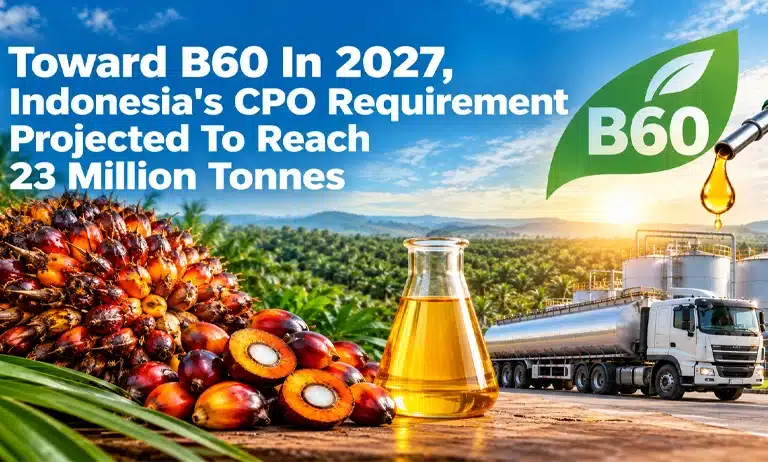
Higher biodiesel blending mandates could create a larger domestic market for the palm oil industry, but will require additional feedstock supplies, processing capacity, and funding readines
Indonesian Palm Oil News (IPO News), Jakarta — Indonesia is preparing to move toward the implementation of B60 biodiesel in 2027. The policy could significantly increase domestic consumption of crude palm oil (CPO), while strengthening the palm oil industry’s role in supporting national energy security.
However, increasing the biodiesel blending ratio involves more than changing the composition of diesel fuel. CPO availability, the industry’s capacity to produce fatty acid methyl ester (FAME), distribution infrastructure, and programme financing will all be critical factors in determining whether the policy can be implemented successfully.
According to a report by ANTARA dated 2 September 2026, Indonesia’s Ministry of Energy and Mineral Resources is assessing CPO supply readiness and biodiesel production capacity to support the proposed B60 rollout in 2027.
The government must also evaluate opportunities to improve plantation productivity and expand FAME processing capacity. This means that any increase in the biodiesel mandate will require coordinated preparation across the entire value chain, from plantations to downstream processing and distribution.
B60 COULD SIGNIFICANTLY INCREASE CPO REQUIREMENTS
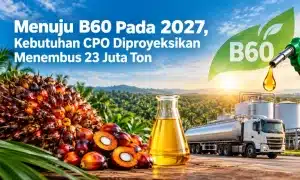
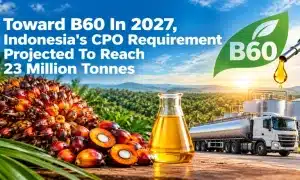
The Indonesian Palm Oil Association (GAPKI) estimates that CPO requirements for the B60 programme could reach approximately 22–23 million tonnes annually. This would be higher than the estimated 16–17 million tonnes required for B50. These projections highlight the potential scale of domestic palm oil demand from the energy sector.
If B60 is implemented, biodiesel could become an increasingly strategic domestic market for Indonesia’s palm oil industry. Higher feedstock demand could strengthen connections between plantations, palm oil mills, vegetable oil processors, and fuel producers.
However, the estimated 22–23 million tonnes represents projected demand rather than actual consumption. Final requirements will depend on the B60 formulation adopted, the volume of fuel distributed, and the government’s implementation arrangements.
The government must also ensure that rising demand from the energy sector remains balanced with the requirements of the food industry, oleochemicals manufacturers, and export markets.
B50 IS A CRITICAL STEP BEFORE B60
Before moving to B60, the government is targeting full implementation of B50 from October 2026. B50 refers to diesel fuel containing 50% biodiesel and 50% petroleum-based diesel. B60, meanwhile, refers to a target blend containing 60% bio-based fuel components under the planned biodiesel programme.
Deputy Minister of Energy and Mineral Resources Yuliot Tanjung has highlighted the need to consolidate CPO availability at the upstream level before increasing the blending mandate. The ministry’s Director General of New, Renewable Energy and Energy Conservation, Eniya Listiani Dewi, has also indicated that the technical specifications for FAME under B60 require further assessment.
One option under consideration is the potential use of hydrotreated vegetable oil (HVO), a renewable diesel produced by processing vegetable oils or fats with hydrogen.
The possibility of combining FAME and HVO still requires technical evaluation. HVO is also estimated to cost approximately 1.5–2 times as much as FAME, meaning that the selected B60 formulation could have significant implications for the programme’s economics.
The government must therefore ensure that higher blending targets are supported by rigorous technical testing and cost assessments to achieve effective implementation.
FAME PRODUCERS COULD BENEFIT FROM A LARGER MARKET
A higher biodiesel mandate could increase demand for facilities that convert feedstocks into FAME. This could create opportunities for companies involved in vegetable oil processing, process technology, plant engineering, industrial machinery, and supporting services.
However, stronger market demand does not automatically mean that all producers will benefit equally. Plant utilisation rates, operating efficiency, feedstock access, and the location of production facilities relative to demand centres will influence each company’s competitiveness.
Distribution readiness is equally important. FAME requires appropriate handling and quality control, including adequate storage, blending, and transportation facilities. Increased production capacity must therefore be accompanied by infrastructure capable of delivering products efficiently across Indonesia.
For industrial technology and equipment suppliers, preparations for B60 could generate demand for automation systems, processing equipment, instrumentation, storage facilities, and fuel quality testing technologies.
The scale of these business opportunities will depend on investment decisions, capacity expansion, and the government’s final implementation arrangements.
PALM OIL PRODUCTIVITY WILL BE KEY
Rising CPO requirements for biodiesel also place plantation productivity at the centre of the industry’s preparations. If domestic demand grows faster than production, competition for CPO between the energy sector, food industry, downstream manufacturers, and export markets could intensify. One approach is to improve productivity on existing plantations through replanting, better cultivation practices, and the use of high-quality planting materials.
Smallholder replanting programmes are particularly important because higher output does not necessarily have to depend on expanding plantation areas. Improving yields per hectare could help increase supplies without placing additional pressure on land conversion.
Productivity improvements must also be supported by better plantation management, access to financing, technical assistance, and reliable market access for smallholders. Through these measures, the palm oil industry could strengthen feedstock availability while maintaining the long-term sustainability of production.
SIGNIFICANT OPPORTUNITIES, BUT READINESS MUST BE MEASURED
Indonesia’s plan to move toward B60 demonstrates the increasingly close relationship between the palm oil industry and national energy strategy. Higher domestic CPO absorption could expand the local market, encourage processing investments, and create opportunities for supporting industries.
However, the programme’s success cannot be measured solely by the blending percentage. Feedstock availability, production efficiency, processing costs, distribution readiness, and sustainable financing must also be taken into account.
The government will need to ensure that increasing energy-sector demand does not undermine supplies for food and downstream industries, while also considering the interests of export markets.
For palm oil industry players, the transition toward B60 should be viewed as both a strategic opportunity and a challenge. Companies that can improve productivity, maintain operational efficiency, and strengthen supply-chain integration may be better positioned to respond to changing market requirements.
With adequate preparation, a higher biodiesel mandate could become an important driver of Indonesia’s palm oil and energy industries. Ultimately, however, the benefits will depend on the entire value chain’s ability to meet growing demand efficiently and sustainably.
Muslim M. Amin, Editor in Chief
To subscribe or for more information, contact: Marketing Or Email
Need a research report? Please visit CDMI Consulting