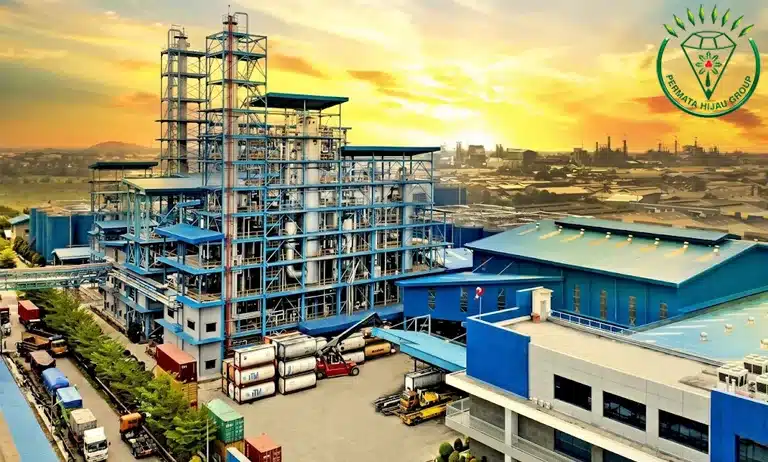
Indonesian Palm Oil News (IPO News), Medan — Permata Hijau Group (PHG), now known as Permata Group, is one of Indonesia’s integrated palm oil business groups with an extensive presence across the palm oil value chain.
Established in 1984, the company has developed its business from plantations into CPO processing, refining, kernel crushing, biodiesel, specialty fats and oleochemicals. Permata Group says its operations cover the palm oil value chain from upstream to downstream, with products marketed to customers in various international markets.
What makes the group particularly interesting is not only the scale of its plantation operations, but also how it processes palm oil raw materials into a broad range of higher value products.
21,000 Hectares of Planted Area
The latest data published by Permata Group in its 2024 Sustainability Report shows that the company manages approximately 21,000 hectares of planted area. From these plantations, Permata Group produces more than 200,000 tonnes of fresh fruit bunches (FFB) annually.
However, the company does not rely solely on its own plantations for raw materials. Permata Group also sources FFB from third party suppliers, including large plantation companies, farmer cooperatives and independent smallholders. In 2024, the group’s six palm oil mills produced approximately 352,000 tonnes of crude palm oil (CPO) and 103,000 tonnes of palm kernel (PK).
These production figures demonstrate that Permata Group’s processing scale is significantly larger than the output generated by its own plantations, as its supply chain is also supported by third-party FFB suppliers.
From Plantations to Downstream Industries
Integration is one of the key strengths of Permata Group, After FFB is processed into CPO and palm kernel, the raw materials can be further processed through the group’s refining, kernel crushing, biodiesel and oleochemical facilities.
Through this integrated model, the company is not simply selling commodities, but is able to develop products with greater added value. Permata Group states that this integrated business model enables it to produce a wide range of value-added products and distribute them to global markets through an integrated logistics network.
Six Holding Companies Supporting the Operations
Permata Group also has a broad corporate structure, According to company documents, the group has several major holding companies, including PT Permata Hijau Palm Oleo, PT Nubika Jaya, PT Permata Hijau Indonesia, PT Permata Hijau Sawit, PT Pelita Agung Agrindustri and PT Damai Nusa Sekawan.
Each holding company manages a number of entities or operating units. Pelita Agung Agrindustri, for example, manages three operations Dumai, Duri and KI while Nubika Jaya manages two operations. This structure demonstrates that Permata Group is not simply a plantation company, but a diversified business group with operations covering multiple segments of the palm oil industry.
Oleochemicals as an Important Business Segment
One of the most interesting parts of Permata Group’s business is its oleochemical operations. Through PT Permata Hijau Palm Oleo, the group has developed fatty acid and downstream oleochemical production capabilities. Palm based oleochemical products can serve as raw materials for a wide range of industries, including food, personal care, consumer products and chemical manufacturing.
This represents a key form of palm oil downstreaming: raw materials originating from plantations are processed further into industrial products with significantly higher economic value.
More Than Just CPO, Permata Group’s portfolio also includes refining, kernel crushing and biodiesel operations. This means that a single integrated ecosystem can generate multiple products from the same agricultural commodity.
CPO can be refined into various oil products and industrial raw materials. Palm kernels can be processed through kernel crushing facilities to produce palm kernel oil and its derivatives. Meanwhile, biodiesel facilities provide the group with exposure to the renewable energy sector based on palm oil, This combination gives Permata Group exposure to several markets at the same time.
International Markets as Part of the Strategy
Permata Group has a long history of international trading activities, One of the entities that has played an important role in the group’s trading operations is Virgoz Oils & Fats Pte. Ltd., based in Singapore. Historical trade data published by PORAM shows that Virgoz handled significant volumes of palm oil products and fatty acids, with markets covering Asia, the Middle East, South Africa, the Mediterranean region and Western Europe.
Although these figures are historical, they demonstrate that international trading has been an important part of Permata Group’s business development for many years.
Large Scale Production Supported by Strategic Suppliers
An important point when looking at Permata Group’s production figures is the source of its raw materials. The group does not rely solely on its own plantations, Company data shows that its supply base includes large plantation companies, farmer cooperatives and independent smallholders.
As a result, the group’s processing capacity can be significantly larger than the FFB production generated by its own plantations. This broad supplier network is therefore an important component in maintaining the continuity of its mill operations.
Commitment to a Sustainable Supply Chain
Permata Group is also continuing to strengthen its sustainability and supply-chain traceability initiatives. The company’s NDPE dashboard shows that several Permata Group facilities have undergone NDPE IRF assessments covering areas such as deforestation and peat.
In 2025, for example, Permata Hijau Sawit recorded a 90% score under the No Deforestation & Peat indicator, while several other facilities were also included in the assessment system. The group’s subsidiaries have also previously received PROPER Green recognition as part of Indonesia’s environmental performance assessment program.
Permata Group and the Future of Palm Oil Downstreaming
The development of Permata Hijau Group demonstrates how a palm oil business can evolve from plantation operations into an integrated industrial group with a broad value chain. With approximately 21,000 hectares of planted area, six palm oil mills, and 2024 production of approximately 352,000 tonnes of CPO and 103,000 tonnes of palm kernel, together with refining, biodiesel and oleochemical operations, Permata Group has a presence across multiple segments of Indonesia’s palm oil industry.
What will be particularly important to watch is not only the growth of its plantation production, but also how far the group can expand its portfolio of higher value downstream products, particularly oleochemicals and other palm based derivatives.
For Indonesia’s palm oil industry, the Permata Group model illustrates that the future of palm oil does not stop at CPO. Greater economic value can be created when palm based raw materials are processed further into industrial products, renewable energy and consumer products for global markets.
To subscribe or for more information, contact: Marketing Or Email
Need a research report? Please visit CDMI Consulting