Indonesian Palm Oil News (IPO News), Bali — Malaysia continues to strengthen the use of palm oil-based biodiesel as part of its efforts to reduce dependence on fossil fuels while increasing domestic utilization of its palm oil resources.
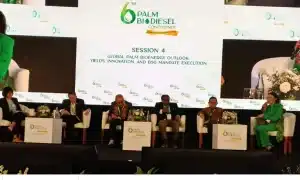
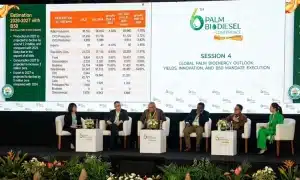
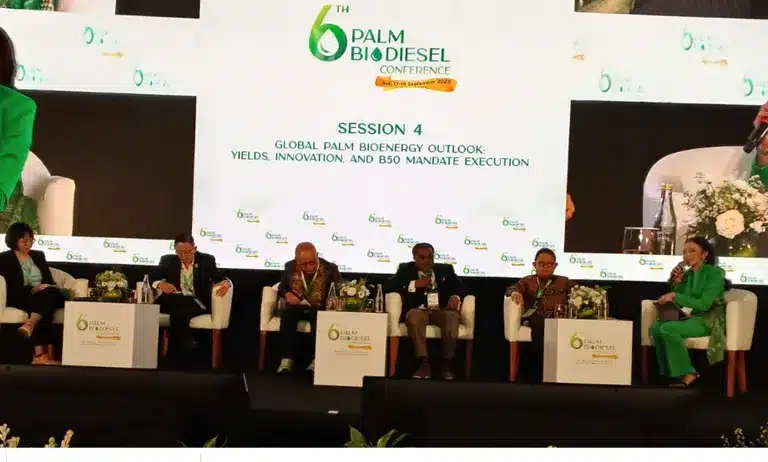
At the 6th Palm Biodiesel Conference 2026, held at Sofitel Nusa Dua, Bali, on September 17–18, 2026, policy and infrastructure readiness were among the key issues discussed. Dr. Sang Yew Ngin, Undersecretary of the Biomass and Biofuel Division at Malaysia’s Ministry of Plantation and Commodities, was one of the speakers in a session addressing the acceleration of biodiesel mandates, industry readiness, and financing for a sustainable transport sector.
Sang Yew Ngin’s earlier statements on Malaysia’s biodiesel development have highlighted infrastructure readiness as one of the key challenges as biodiesel blending levels are increased.
From B10 to B15, B20 and B30
Malaysia currently implements a B10 mandate for vehicles, consisting of 10 percent biodiesel blended with 90 percent diesel. The Malaysian government has been encouraging increased production capacity and infrastructure development to support B15 and, progressively, B20 and B30.
Sang Yew Ngin explained that Malaysia has 34 biodiesel blending depots, but most of these facilities were originally designed to handle B10 volumes.
As a result, increasing the blending level requires upgrades to existing infrastructure. According to him, infrastructure enhancement cannot be completed within a short period and may require approximately one to two years, along with significant capital expenditure.
Infrastructure as a Major Challenge
Higher biodiesel blending levels automatically increase the volume of biodiesel that must be produced, blended, stored and distributed.
Blending depots and terminals therefore need to be capable of handling larger volumes. The government and industry must ensure that facilities are adequately prepared before higher blending mandates are implemented on a wider scale.
In this context, infrastructure development and upgrading have become important components of Malaysia’s biodiesel roadmap.
The challenge is not only to build new facilities, but also to upgrade existing infrastructure so that it can meet operational requirements and standards at higher blending levels.
The Road Toward B30
Malaysia views increased biodiesel utilization as part of its efforts to reduce dependence on fossil fuels and strengthen national energy security.
However, the journey toward B30 requires comprehensive preparation. In addition to feedstock availability and biodiesel production capacity, blending depots, terminals, storage facilities and distribution networks must also be ready.
According to a report citing Sang Yew Ngin, upgrading the infrastructure requires both time and investment. The investment required to upgrade terminals and infrastructure to support Malaysia’s B30 mandate has been estimated at approximately US$151 million.
This demonstrates that increasing the biodiesel mandate is not simply a matter of setting a higher blending percentage. It also requires the development of a fully prepared energy ecosystem.
Lessons for the Palm Oil Industry
Malaysia’s development is highly relevant to Indonesia, which has entered the B50 era. Both countries have large palm oil industries and view biodiesel as an important instrument for increasing domestic utilization of palm oil.
Indonesia has moved further in terms of its biodiesel blending level, while Malaysia is taking a gradual approach by considering infrastructure and industry readiness.
The exchange of experience between the two countries is becoming increasingly important because they face several common challenges, particularly in industry readiness, infrastructure, distribution, financing and program sustainability.
Sang Yew Ngin’s participation in the 6th Palm Biodiesel Conference in Bali also strengthened the regional dimension of the event. The conference brought together stakeholders from Indonesia, Malaysia and Thailand to discuss the future of palm-based biodiesel and its role in global energy security.
Biodiesel and Energy Security
For Malaysia, the development of palm-based biodiesel is not solely related to the plantation sector. The program is also part of the country’s broader energy strategy.
As domestic biodiesel utilization increases, palm oil is expected to play a greater role in meeting the energy requirements of the transportation sector.
However, such development must be supported by readiness across the entire supply chain. Production, blending, storage, transportation and distribution must advance in line with higher blending mandates.
Malaysia’s experience therefore demonstrates that ambitious biodiesel blending targets must go hand in hand with infrastructure readiness and investment.
On the road toward B30, Malaysia’s challenge is not simply to ensure biodiesel availability, but to build a system capable of producing, blending and distributing larger volumes efficiently and sustainably.
To subscribe or for more information, contact: Marketing Or Email
Need a research report? Please visit CDMI Consulting