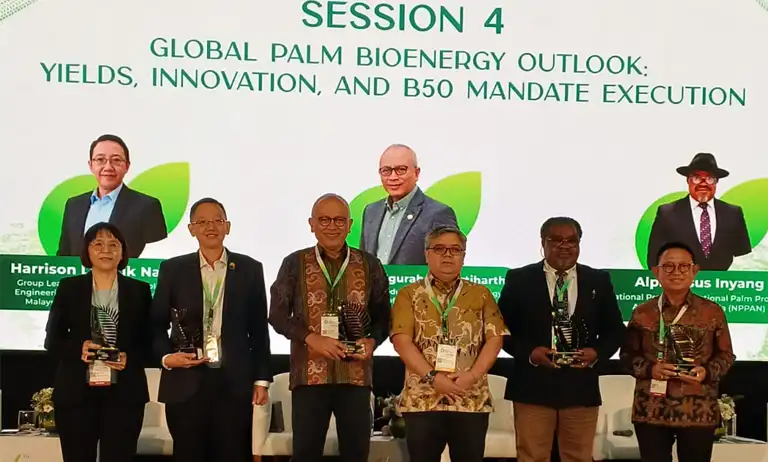
Indonesian Palm Oil News (IPO News), Bali — The implementation of Indonesia’s B50 biodiesel program is expected to have a significant impact on global palm oil supply and trade. At the same time, Africa sees an opportunity to strengthen its position in the global palm oil industry as demand continues to grow.
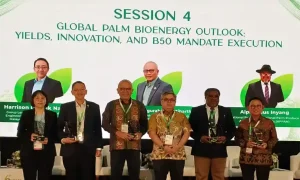
These issues were among the key topics discussed at the 6th Palm Biodiesel Conference 2026, held in Bali on September 17–18, 2026. The international forum brought together industry leaders, policymakers, associations, and stakeholders from Indonesia and other palm oil-producing regions.
Two speakers who attracted particular attention were Eddy Martono, Chairman of the Indonesian Palm Oil Association (GAPKI), and Amb. Alphonsus Inyang, President of the National Palm Produce Association of Nigeria (NPPAN).
Indonesia’s Palm Oil Supply Remains Strong
In his presentation, Eddy Martono outlined Indonesia’s palm oil supply and demand outlook following the implementation of the B50 biodiesel program.
Indonesia’s combined crude palm oil (CPO) and palm kernel oil (PKO) production in 2026 is projected to reach approximately 58.8 million tons. Domestic consumption is estimated at around 27.1 million tons, while exports are projected at approximately 31.1 million tons.
According to Eddy, Indonesia has fundamentally sufficient palm oil supply to support the implementation of B50.
However, the increasing allocation of palm oil for domestic biodiesel consumption will inevitably affect the volume available for export.
For 2027, Indonesia’s combined CPO and PKO production is projected to decline to around 56.6 million tons, partly due to weather-related factors. Meanwhile, domestic consumption is expected to increase to approximately 30.2 million tons.
Biodiesel consumption is projected to rise significantly, reaching around 17.4 million tons, an increase of approximately 18.4%.
Exports Could Decline by Nearly 5 Million Tons
One of the most important implications highlighted at the conference is the potential reduction in Indonesian palm oil exports.
Eddy projected that exports could decline from around 31.1 million tons in 2026 to 26.4 million tons in 2027, representing a reduction of approximately 4.7 million tons, or nearly 5 million tons.
This development could have broader implications for the international palm oil market, particularly because Indonesia is the world’s largest palm oil producer and a major supplier to global markets.
The growing domestic allocation for biodiesel means that global buyers may face tighter availability of Indonesian palm oil, particularly if production growth does not keep pace with rising domestic demand.

Africa Sees a Strategic Opportunity
Against this backdrop, Africa is increasingly looking at the global palm oil market as an important opportunity.
Amb. Alphonsus Inyang, one of the African speakers at the 6th Palm Biodiesel Conference 2026, emphasized the need for African countries to position themselves to capture the growing global demand for palm oil.
Nigeria, Africa’s largest economy and one of the continent’s major palm oil markets, still faces a significant gap between domestic production and consumption.
Nigeria’s palm oil consumption is estimated at around 2.4 million tons per year, while domestic production is approximately 1.5 million tons, leaving a substantial supply deficit.
A large proportion of Nigeria’s palm oil production also comes from smallholders. Strengthening smallholder productivity, improving planting materials, adopting better agricultural practices, modernizing processing facilities, and accelerating replanting are therefore considered important steps for increasing production.
B50 Could Reshape Global Palm Oil Dynamics
The development of biodiesel programs in Indonesia and other palm oil-producing countries is gradually changing the structure of global palm oil demand.
Indonesia’s B50 program will increase domestic demand for palm oil-based biodiesel, potentially reducing the volume available for export. Malaysia is also expanding its biodiesel utilization, adding further pressure to global supply.
For African producers, this situation could create an opportunity to increase production and become a more important contributor to the global palm oil supply chain.
However, realizing this opportunity will require substantial improvements in productivity, infrastructure, technology, processing capacity, financing, and farmer development.
Smallholders Remain the Key
Both Indonesia and Nigeria face a similar challenge: the important role of smallholders in the palm oil sector.
Increasing productivity from existing plantations could provide a more sustainable pathway for increasing production without relying primarily on the expansion of plantation areas.
For Indonesia, improving smallholder productivity is particularly important as the country seeks to balance three major objectives: food security, energy security, and export performance.
For Africa, improving smallholder productivity could help narrow the gap between domestic supply and consumption while creating new opportunities for the region to participate more strongly in the global palm oil market.
A Warm Conversation with Nigeria’s Palm Oil Leader
The presence of Amb. Alphonsus Inyang in Bali also provided an opportunity for Muslim M. Amin, Editor-in-Chief of IPO NEWS, to have a direct conversation with the Nigerian palm oil industry leader on the sidelines of the conference.
The conversation took place in a warm and relaxed atmosphere. Inyang was friendly and open in discussing developments and opportunities in the global palm oil industry.
Muslim M. Amin also had the opportunity to take a photograph together with Inyang, documenting IPO NEWS’s presence and engagement at the international palm biodiesel forum.
The encounter added a valuable international dimension to IPO NEWS’s coverage of the conference, particularly as the global palm oil industry enters a period of significant transformation driven by biodiesel demand, changing trade flows, productivity challenges, and the emergence of new production opportunities in Africa.

Global Palm Oil Industry at a Turning Point
The discussions between Indonesian and African industry leaders at the 6th Palm Biodiesel Conference 2026 demonstrate that the future of the global palm oil industry will not be determined solely by production volumes.
The allocation of palm oil for energy, rising domestic consumption, export availability, plantation productivity, and the development of smallholders will increasingly shape global market dynamics.
As Indonesia moves forward with B50, Africa has an opportunity to strengthen its role in meeting future palm oil demand. The next phase of the industry will therefore depend not only on how much palm oil the world can produce, but also on how efficiently and sustainably that supply can be developed.
To subscribe or for more information, contact: Marketing Or Email
Need a research report? Please visit CDMI Consulting