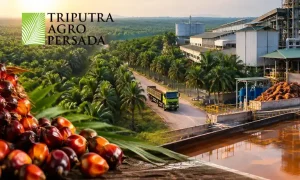
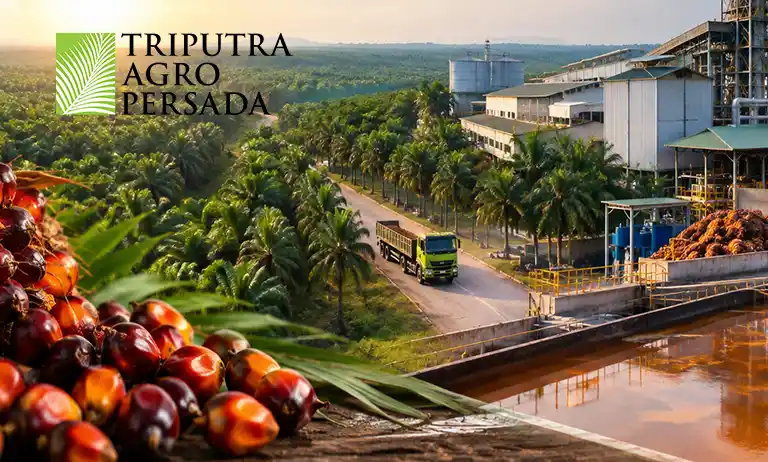
Indonesian Palm Oil News (IPO News), Jakarta — Triputra Group is widely known as one of Indonesia’s major business groups, with operations spanning several industries. In the palm oil sector, however, the group’s strength is anchored by PT Triputra Agro Persada Tbk (TAPG).
With approximately 159,700 hectares of planted oil palm area in 2025 and CPO production of around 953,000 tonnes, TAPG is one of Indonesia’s large-scale plantation players. In addition to CPO, the company produces palm kernel (PK) and palm kernel oil (PKO), while developing businesses based on plantation by-products and renewable energy.
Nearly 160,000 Hectares of Oil Palm
TAPG’s official report shows that its total planted oil palm area reached approximately 159,700 hectares in 2025. Of this total, around 132,800 hectares were core plantations, while approximately 26,900 hectares were plasma plantations. TAPG also manages around 1,300 hectares of rubber plantations.
This scale provides Triputra with a substantial production base to supply palm oil processing operations while supporting the development of downstream businesses.
In 2025, TAPG’s CPO production, including its associated companies, reached approximately 953,000 tonnes, an increase of around 4% from 2024. PK production reached 202,000 tonnes, while PKO production stood at approximately 22,000 tonnes.
These figures show that Triputra’s palm oil business extends beyond plantations and CPO production. Processing and monetizing palm kernel derivatives are also becoming increasingly important parts of its value chain.
From CPO to Value-Added Products
According to information received by Indonesian Palm Oil News (IPO NEWS), one of TAPG’s notable developments is its effort to increase the economic value of plantation and mill by-products.
TAPG has developed biogas power plants by utilizing palm oil mill effluent (POME). In Sukamara, Central Kalimantan, one of TAPG’s biogas facilities has a capacity of approximately 2 MW, with actual utilization reported at around 1.6 MW. Part of the generated energy is used to support the company’s kernel crushing plant and internal facilities.
TAPG has also developed biocoke from palm kernel shells through cooperation with Japanese company Aisin Takaoka. Triputra Group describes the initiative as part of its efforts to create additional value from palm oil industry by-products.
This indicates that TAPG is gradually moving beyond a conventional plantation model toward broader utilization of the palm oil production chain.
B50 and the Productivity Challenge
The changing structure of Indonesia’s CPO market following the implementation of B50 is also an important factor for a company with TAPG’s production scale.
B50 has increased domestic CPO requirements, while plantation production continues to face weather and crop-age challenges. In the first quarter of 2026, TAPG recorded FFB production of approximately 698,000 tonnes, down 6% year-on-year, while CPO production declined by around 2%.
The development highlights the fact that increasing production is not simply a matter of expanding plantation acreage. Productivity per hectare is becoming increasingly important.
TAPG has also implemented productivity improvement programs for smallholders through agronomic training involving its subsidiaries in Jambi, Central Kalimantan and East Kalimantan.
Latest Corporate Developments
In September 2026, TAPG attracted attention following the sale of 99.9% of its shares in PT Alam Belantara Makmur to PT Agraus Resources for US$450,000 on September 23. The company stated that the transaction would not have a material impact on its operations or financial condition.
During the same period, Arif Rachmat, son of T.P. Rachmat, was reported to have purchased 500,000 TAPG shares on September 23, with a transaction value of approximately Rp999.5 million for investment purposes.
These developments indicate that TAPG remains active in portfolio management and corporate activities amid changes in Indonesia’s palm oil industry.
Maintaining Production Amid Market Changes
With nearly 160,000 hectares of planted oil palm, CPO production approaching 1 million tonnes annually, and operations involving PKO, biogas and biocoke, Triputra Agro Persada has established a broad business chain extending from plantations to the utilization of palm oil by-products.
The next challenge is maintaining plantation productivity amid changing weather patterns while meeting growing domestic demand following the implementation of B50.
For Triputra, future growth is not simply about expanding plantation acreage. Efficiency, productivity, technology, downstream development and by-product utilization are becoming increasingly important elements of its palm oil business strategy.
With this foundation, Triputra Agro Persada represents a significant asset within Triputra Group’s agribusiness portfolio, while also demonstrating how major Indonesian business groups are increasingly developing palm oil beyond CPO as a commodity, toward a broader and more integrated value-creation ecosystem.
Muslim M. Amin
Editor in Chief
Indonesian Palm Oil News (IPO NEWS)
To subscribe or for more information, contact: Marketing Or Email
Need a research report? Please visit CDMI Consulting