Production Grows, Biodiesel Boosts Domestic Demand, and Downstream Processing Becomes Increasingly Important
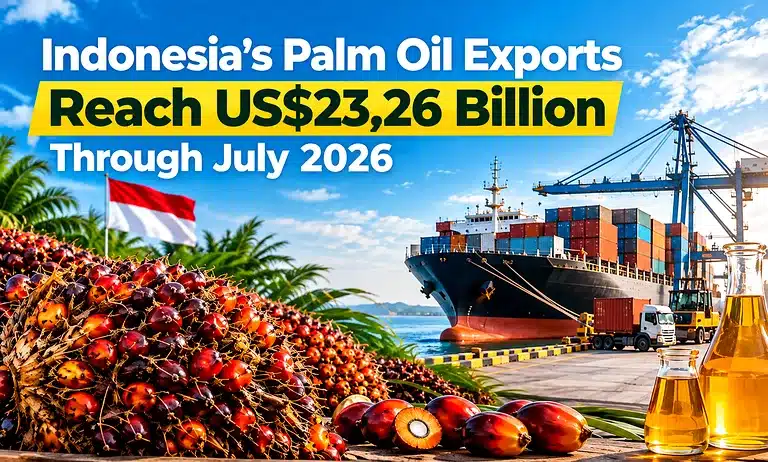
Indonesian Palm Oil News (IPO News), Jakarta — Indonesia’s palm oil industry continued to demonstrate solid export performance during January–July 2026. According to the latest data from the Indonesian Palm Oil Association (GAPKI), the country’s palm oil export value reached approximately US$23.26 billion, an increase of 10.92% compared with US$20.97 billion during the same period in 2025.
The increase in export value came amid higher production and growing domestic demand for palm oil, particularly from the biodiesel sector. Cumulative CPO and PKO production during January–July 2026 reached approximately 35.65 million tonnes, up 6.45% from 33.49 million tonnes in the same period last year. Meanwhile, domestic consumption reached approximately 15.21 million tonnes, increasing 6.38% year on year.
Biodiesel Becomes a Major Demand Driver
The increase in domestic consumption highlights the growing role of Indonesia’s downstream palm oil industries. One of the main drivers is the biodiesel sector. In July 2026 alone, CPO absorption for biodiesel reached approximately 1.28 million tonnes, up 13.59% from around 1.13 million tonnes in June.
This reflects an important shift in Indonesia’s palm oil demand structure. A portion of palm oil production that could previously have entered export markets is increasingly being absorbed domestically, particularly for renewable energy production based on palm oil.
Export Volume Rises, but July Shows Some Pressure
Although cumulative export value increased by double digits, monthly performance in July showed some pressure. Total palm oil product exports in July 2026 stood at approximately 3.18 million tonnes, down 2.67% from 3.27 million tonnes in June. The decline was mainly driven by lower exports of crude palm oil, which fell 25.70% to approximately 249,000 tonnes.
However, not all product categories declined. Exports of oleochemical products increased 14.94% to approximately 537,000 tonnes. This development provides an important signal for the national palm oil industry. Export growth is no longer determined solely by the volume of crude palm oil shipped overseas. Indonesia’s ability to develop higher value downstream products is becoming increasingly important.
China Gains Ground, While India Weakens
Indonesia’s export destinations also showed different trends across major markets. In July 2026, exports to the European Union reached approximately 104,000 tonnes, up 40% from June. Exports to the United States increased 20% to 44,000 tonnes, while exports to Africa rose 17% to 61,000 tonnes.
China also continued to record positive growth, with July exports reaching approximately 25,000 tonnes, an increase of 4% month on month. In contrast, exports to India declined 20%, while shipments to Russia plunged 69%. Exports to Malaysia fell 32%, and Pakistan declined 17%.
On a cumulative January–July 2026 basis compared with the same period in 2025, exports to China increased 30%, Malaysia 14%, Africa 5%, and the European Union 4%. Meanwhile, exports to India declined by approximately 20%.
Strong Export Earnings Amid Structural Changes
The January–July 2026 performance confirms that palm oil remains one of Indonesia’s important sources of foreign exchange. The US$23.26 billion export value was supported by higher average CPO export prices. The average CPO export price during the first seven months of 2026 was approximately US$1,137 per tonne, compared with US$1,075 per tonne during the same period in 2025.
However, the industry is also facing structural changes. On one hand, domestic consumption continues to rise as biodiesel demand expands. On the other hand, export growth increasingly requires higher value products rather than relying primarily on crude palm oil.
With ending stocks at approximately 2.75 million tonnes at the end of July, developments in production, domestic consumption, biodiesel demand, and exports will remain important factors in determining Indonesia’s palm oil supply balance during the second half of 2026.
For Indonesia’s palm oil industry, the US$23.26 billion export figure represents more than the value of international trade. It also reflects the changing direction of the industry from primarily supplying raw materials to global markets toward an industry increasingly driven by downstream processing, palm based energy, and higher value products.
Muslim M. Amin
Editor in Chief, IPO NEWS
To subscribe or for more information, contact: Marketing Or Email
Need a research report? Please visit CDMI Consulting