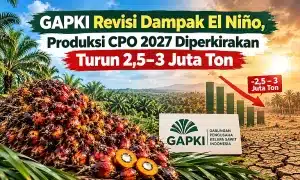
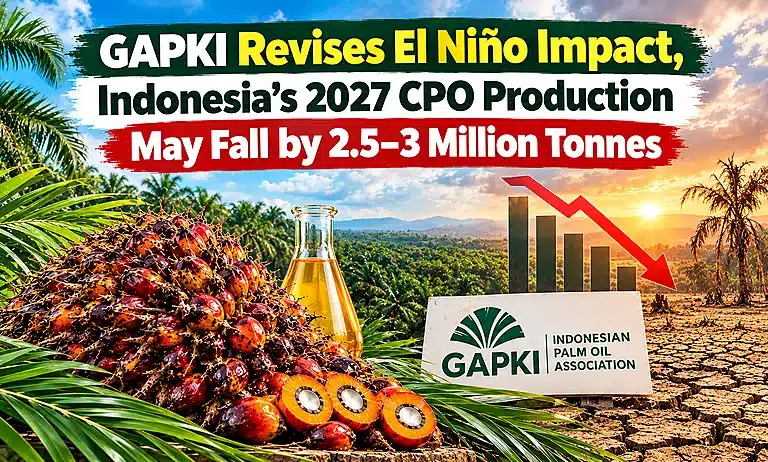
Indonesian Palm Oil News (IPO News), Jakarta — The Indonesian Palm Oil Association (GAPKI) has revised its estimate of the impact of El Niño on Indonesia’s palm oil production in 2027. While the initial projection indicated a potential decline of around 4–5 million tonnes, GAPKI’s latest estimate puts the decline at approximately 2.5–3 million tonnes.
The revised estimate was conveyed by GAPKI Chairman Eddy Martono on September 7, 2026. According to Eddy, several palm oil-producing regions were still receiving rainfall, meaning the potential production decline could be smaller than initially projected. Nevertheless, prolonged hot and dry conditions could still affect plantation productivity and next year’s harvest.
El Niño Impact Expected to Emerge in 2027
According to information received by Indonesian Palm Oil News (IPO NEWS), one of the key challenges associated with El Niño is the time lag between extreme weather conditions and their impact on fresh fruit bunch (FFB) yields and CPO production. Hot and dry conditions during 2026 could affect plant growth and plantation productivity, with the consequences becoming more visible in 2027 production.
Eddy Martono estimates that Indonesia’s CPO production in 2027 could decline by around 2.5–3 million tonnes due to the effects of El Niño. The projection has become an important consideration as the palm oil industry is simultaneously facing growing domestic CPO demand, particularly from the biodiesel sector.
Although the revised estimate is lower than the initial projection, a potential decline of several million tonnes would still be significant for Indonesia’s overall palm oil supply balance.
B50 Is Underway, While B60 Presents a New Challenge
The production risk is becoming more important as Indonesia has already implemented the B50 biodiesel program, while the government is also considering moving toward B60.
GAPKI has estimated that full implementation of B50 could increase annual CPO requirements for biodiesel to around 16.3–17 million tonnes. With domestic demand increasing, the amount of CPO available for exports could become tighter if production growth fails to keep pace.
Eddy Martono has also indicated that the planned B60 program in 2027 could face challenges if CPO production declines because of El Niño. In his September statement, he expressed doubts that 2027 production conditions would be sufficient to support B60 implementation.
This highlights two pressures emerging at the same time: production could decline, while domestic CPO demand continues to increase.
Export Availability Could Become the Adjustment Factor
For the global market, the development is significant because Indonesia remains one of the world’s major palm oil suppliers.
If national production declines while domestic requirements continue to receive priority, adjustments could increasingly occur through lower export availability.
GAPKI has previously emphasized that domestic requirements would be prioritized. Therefore, if CPO supply falls, the volume available for export could be reduced.
Such a development could affect the global CPO supply balance, particularly if production from other major producing countries is unable to fully compensate for reduced Indonesian availability.
Productivity Becomes Critical
GAPKI’s revised projection shows that the El Niño risk remains an important issue, even though its estimated impact is now lower than the initial forecast.
For Indonesia’s palm oil industry, the challenge ahead is not simply maintaining plantation acreage, but also improving productivity per hectare.
Replanting, high-quality planting material, proper fertilizer application, better plantation management and technology adoption will become increasingly important to support production growth.
This is particularly relevant as domestic biodiesel demand continues to expand. Every increase in domestic CPO consumption needs to be accompanied by higher production if Indonesia is to maintain sufficient supplies for downstream industries and export markets.
With production now projected to potentially decline by 2.5–3 million tonnes in 2027, the industry still has an opportunity to strengthen mitigation measures. The key question is how quickly productivity improvements can be achieved before the effects of El Niño become fully reflected in next year’s production.
Muslim M. Amin
Editor in Chief
Indonesian Palm Oil News (IPO NEWS)
To subscribe or for more information, contact: Marketing Or Email
Need a research report? Please visit CDMI Consulting