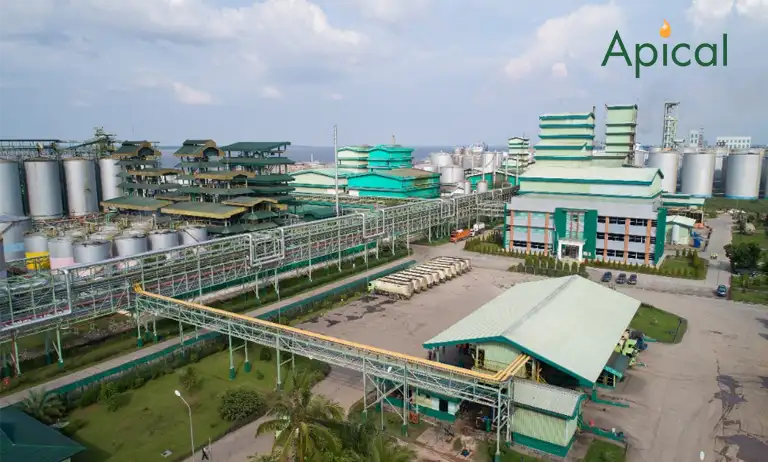
Indonesian Palm Oil News (IPO News), Jakarta — If Asian Agri represents one of the key upstream strengths within the RGE palm oil ecosystem, Apical operates on the downstream side, with an extensive processing and marketing network serving global markets.
Apical is a palm oil processor and exporter headquartered in Singapore. According to the company’s official profile, Apical has more than 3,000 employees across five countries, with its products marketed in more than 50 countries.
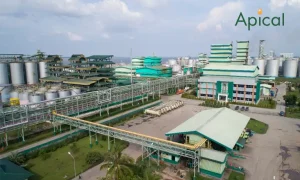
Its business network includes 8 refineries, 5 biodiesel plants, 2 palm kernel processing facilities and 6 oleochemical plants. This structure demonstrates that Apical’s business extends beyond commodity trading and refining into a broad range of value-added palm-based products.
From Palm Oil to Value-Added Products
Apical has developed an integrated downstream business covering palm oil refining, palm kernel processing, oleochemicals, specialty fats and renewable fuels.
Its oleochemical portfolio includes products such as fatty acids, soap noodles and glycerin, which are used in a wide range of industrial applications.
This downstream model enables Apical to capture additional value from palm oil rather than relying solely on the sale of commodities in their basic forms.
The company says its business network serves the food, feed, oleochemical and renewable fuel industries. Apical also operates logistics networks connecting raw material sourcing, refining, processing and distribution to customers.
An Industrial Network Spanning Asia and Europe
Apical’s operations extend across several countries.
In Indonesia, its facilities include PT Asianagro Agungjaya Marunda in Jakarta, PT Asianagro Agungjaya Tanjung Balai in North Sumatra, PT Sari Dumai Sejati in Riau, PT Kutai Refinery Nusantara in East Kalimantan, PT Padang Raya Cakrawala in West Sumatra and PT Sari Dumai Oleo in Dumai.
Outside Indonesia, Apical also has operations in Nanjing, China, and Huelva, Spain.
Its presence in Spain has strategic importance. Apical acquired Bio-Oils in 2016 to strengthen its position in the European biodiesel market. The Huelva biodiesel facility in La Rábida has an annual production capacity of 459,000 tonnes of biodiesel and refined CPO products, according to the capacity stated by the company.
This network gives Apical proximity to both Asian and European markets, while providing the ability to transform palm-based raw materials into a broad portfolio of downstream products.
Traceability as a Critical Component
The scale of Apical’s processing network also makes supply-chain traceability an important part of its business.
The company provides information on its supply chain through traceability systems covering refineries, palm kernel processing facilities, oleochemical plants and biodiesel operations.
Apical also publishes supplier-related information for several of its facilities, including updates extending into the second quarter of 2026 for certain operating units.
This has become increasingly important as global markets demand not only palm oil products, but also greater transparency regarding the origin of raw materials, sustainability compliance and the ability of companies to demonstrate responsible supply chains.
Connecting Asian Agri and Apical
Asian Agri and Apical are part of the broader RGE business ecosystem, but they have different operating roles.
Asian Agri focuses on upstream activities, including plantations and palm oil mills, while Apical operates in downstream processing, refining, value-added products and global marketing.
It is also important to distinguish their ownership structures. Apical should not simply be described as the owner of Asian Agri’s plantations. Apical sources raw materials from a network of suppliers, with Asian Agri among its long-term suppliers.
The relationship is therefore more accurately viewed as part of RGE’s broader palm oil ecosystem, connecting upstream production with downstream processing and global markets.
Downstream Products and the Future of Palm Oil
Apical’s development highlights an important direction for Indonesia’s palm oil industry: economic value is determined not only by the volume of CPO produced, but increasingly by how far the commodity can be processed into higher-value products.
With 8 refineries, 5 biodiesel plants, 2 palm kernel processing facilities and 6 oleochemical plants, Apical has established an industrial platform extending from crude palm oil into food products, oleochemicals, specialty fats and renewable energy.
For Indonesia’s palm oil industry, this development illustrates that the future of the sector lies not only in plantations and palm oil mills, but also in the ability to build a complete value chain from upstream production to finished products and global markets.
Muslim M. Amin
Editor in Chief
Indonesian Palm Oil News (IPO NEWS)
To subscribe or for more information, contact: Marketing Or Email
Need a research report? Please visit CDMI Consulting