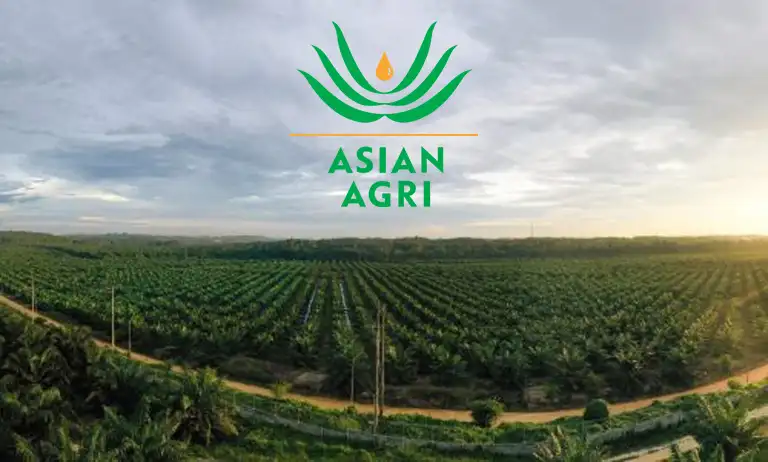
Indonesian Palm Oil News (IPO News), Jakarta — Asian Agri has built one of Indonesia’s significant integrated palm oil ecosystems, combining large-scale plantations, palm oil mills, research and development, renewable energy initiatives, and partnerships with thousands of smallholder farmers.
Established in 1979, Asian Agri manages approximately 100,000 hectares of company-owned oil palm plantations across North Sumatra, Riau and Jambi. In addition, the company works with smallholders covering around 60,000 hectares, involving more than 30,000 farmers.
Together, these areas form an extensive palm oil ecosystem connecting plantation production with smallholder development and downstream processing.
30 Plantations and 23 Palm Oil Mills
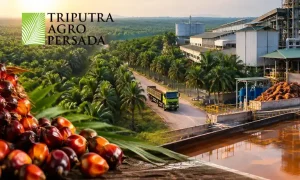
Asian Agri operates around 30 plantations and 23 palm oil mills, producing crude palm oil (CPO) and crude palm kernel oil (CPKO).
The company’s plantation and milling operations provide an integrated foundation for managing the palm oil supply chain, from fresh fruit bunches (FFB) production to the processing of palm oil and palm kernel products.
Its partnership with smallholders is also an important component of the business model. Through long-term partnership programs, Asian Agri has worked to improve farmers’ productivity, plantation management and access to better agricultural practices.
Research as a Key Strength
One of Asian Agri’s notable capabilities is its long-term investment in research and development.
The company’s R&D Centre in Tebing Tinggi, North Sumatra, was established in 1989 and supports research in agronomy, soil management, pest and disease control, plant breeding, biotechnology and tissue culture.
Asian Agri has also developed its Topaz oil palm planting material. According to the company, more than 170 million Topaz seedlings have been distributed to plantations and farmers.
This research capability is strategically important for improving productivity while addressing challenges such as climate variability, pest pressure and the need to reduce agricultural inputs.
Biological Pest Control
The company’s latest initiatives also show how biological approaches are becoming part of plantation management.
In September 2026, Asian Agri highlighted the use of Tahuru ants, predatory ants from the Crematogaster genus, as part of an integrated pest management approach to control bagworms, a pest that can damage oil palm leaves.
Asian Agri reported that the use of three targeted insecticides declined from 102,860 kilograms in 2022 to 72,981 kilograms in 2025, representing a reduction of approximately 29%.
The company’s AA2030 sustainability target is to achieve a 50% reduction in the use of targeted insecticides from its 2022 baseline by 2030.
Palm Kernel Shells Become Renewable Energy
Asian Agri is also utilizing palm oil processing residues as a source of renewable energy.
Palm kernel shells are used as biomass fuel in the company’s operations. In 2025, Asian Agri reported using approximately 509 terajoules of energy from palm kernel shells.
The initiative demonstrates how plantation and mill waste can be converted into an energy resource, while supporting the company’s efforts to improve resource efficiency and reduce reliance on fossil fuels.
Connected to a Wider RGE Ecosystem
Asian Agri is part of RGE, a global group with businesses spanning several sectors, including pulp and paper, palm oil, viscose and energy.
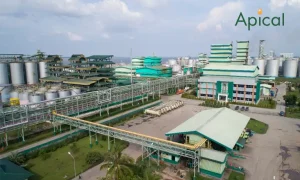
Within the palm oil business, Asian Agri represents the upstream plantation and milling operations, while Apical operates in the downstream palm oil sector.
The relationship creates an extensive business ecosystem covering the supply of palm oil commodities, processing and downstream products. However, the distinction between the two businesses remains important: Apical does not own Asian Agri’s plantations or mills and sources palm oil products from third-party suppliers, with Asian Agri among its long-term suppliers.
This structure provides a broader connection between upstream production and downstream markets while maintaining separate operating entities.
A Large Ecosystem with a Long-Term Challenge
With approximately 100,000 hectares of company-owned plantations, 60,000 hectares involving smallholders, 23 palm oil mills and more than 30,000 farmers, Asian Agri has developed an ecosystem that extends well beyond plantation production.
Its investments in research, improved planting materials, biological pest management, farmer partnerships and renewable energy indicate an effort to strengthen productivity while addressing environmental and operational challenges.
For Indonesia’s palm oil industry, the scale of such an integrated ecosystem also highlights the importance of maintaining productivity growth, strengthening smallholder partnerships and increasing the value generated from every part of the palm oil supply chain.
Muslim M. Amin
Editor in Chief
Indonesian Palm Oil News (IPO NEWS)
To subscribe or for more information, contact: Marketing Or Email
Need a research report? Please visit CDMI Consulting