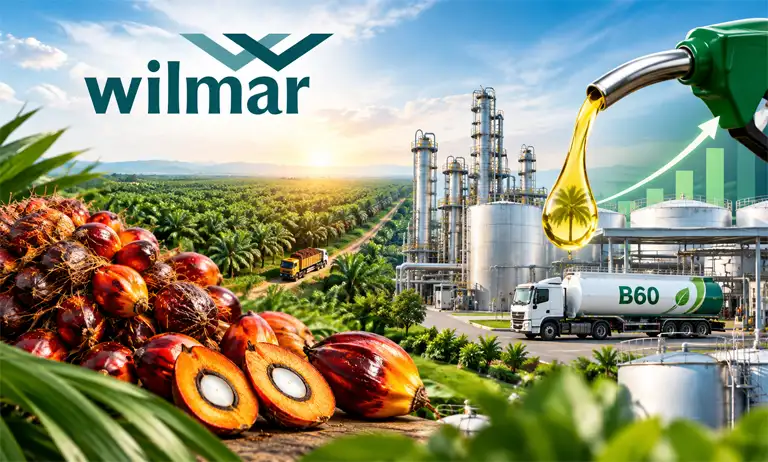
The Global Agribusiness Giant Enters a New Chapter — From Plantations and Downstream Integration to Indonesia’s Biodiesel Industry
Indonesian Palm Oil News (IPO News), Jakarta — Wilmar International continues to demonstrate its strength as one of the world’s leading agribusiness groups. In the first half of 2026, the company recorded revenue of US$38.56 billion, representing a 17.2% increase from US$32.89 billion in the same period of 2025.
Profit before tax rose 12.8% to approximately US$1.06 billion, while core net profit increased 9.9% to US$641.5 million. Net profit reached US$608.9 million, up 2.3%.
The stronger performance was primarily supported by the Feed & Industrial Products and Food Products segments.
Behind these strong figures, however, Wilmar is entering an increasingly complex business environment. The company’s challenges are no longer limited to CPO prices, plantation productivity and downstream expansion, but increasingly include regulatory, trade-compliance and corporate governance issues.
234,334 Hectares of Oil Palm Plantations
Wilmar is among the world’s largest oil palm plantation operators. As of December 31, 2025, the Group had a total planted area of 234,334 hectares, with approximately 66% located in Indonesia, 25% in East Malaysia and 9% in Africa.
The age profile of its plantations also provides an important foundation for long-term productivity. Around 47% of the planted area is within the prime production age of 7–18 years, while approximately 20% is six years old or younger.
Wilmar continues to implement replanting and agronomic improvement programmes to maintain long-term productivity.
In 2025, the Group’s oil palm plantations produced approximately 4.04 million tonnes of fresh fruit bunches (FFB), compared with around 4.11 million tonnes in 2024.
The direction is clear: Wilmar’s future plantation strategy is not simply about expanding acreage, but about improving productivity, yields and operational efficiency.
US$38.56 Billion in Revenue, but the Growth Engine Is Shifting
Wilmar’s first-half 2026 performance also highlights the increasing importance of diversification.
Feed & Industrial Products recorded a 55% increase in profit before tax to US$591.0 million, while Food Products delivered a 56% increase to US$304.6 million.
In contrast, Plantation & Sugar Milling recorded a 32% decline in profit before tax to approximately US$137.7 million. The palm plantation business was affected by lower FFB production, particularly in Indonesia.
This performance illustrates one of the defining characteristics of Wilmar’s strategy: plantations remain a fundamental part of the business, but downstream processing and value-added businesses are becoming increasingly important growth drivers.
Wilmar operates an integrated agribusiness model covering oil palm cultivation, oilseed crushing, edible oils refining, food manufacturing, specialty fats, oleochemicals, biodiesel, fertilisers and other agribusiness activities.
The Group operates more than 1,000 manufacturing plants and has an extensive distribution network covering China, India, Indonesia and around 50 other countries and regions.
B50 Creates Opportunity, While B60 Presents the Next Challenge
Indonesia has entered a new phase in its biodiesel development.
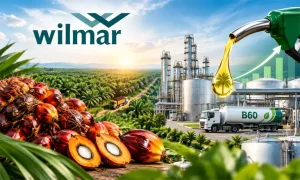
The implementation of B50 in 2026 is expected to further increase domestic demand for biodiesel feedstock. For a company such as Wilmar, with a strong position across the palm oil supply chain and downstream biodiesel business, this creates a significant strategic opportunity.
However, moving towards B60 will not be straightforward.
A higher blending mandate means greater requirements for feedstock availability, processing capacity, infrastructure and investment. The industry must also ensure that additional capacity remains economically viable.
With its extensive palm oil processing and downstream operations, Wilmar is strategically positioned to benefit from Indonesia’s biodiesel expansion.
At the same time, the company must prepare for the additional capital requirements and supply-chain challenges that could accompany a further increase in the biodiesel mandate.
Sustainability and Traceability Are Becoming More Critical
Wilmar is also facing increasingly stringent expectations regarding sustainability.
The company has continued to strengthen its palm oil traceability programme and its commitment to responsible sourcing.
For a company operating on such a large scale, sustainability is no longer simply a matter of corporate reputation. Traceability has become increasingly important for market access, relationships with multinational customers and long-term risk management.
Wilmar’s No Deforestation, No Peat, No Exploitation (NDPE) approach also forms an important part of its sustainability framework.
The direction is increasingly clear: the competitiveness of a global palm oil company will depend not only on how much it produces, but also on how transparently and responsibly its supply chain operates.
Legal and Regulatory Challenges: A Chapter to Watch Closely
Amid its business expansion and strong financial performance, Wilmar is also facing legal and regulatory developments that deserve close attention.
In May 2026, Indonesia’s Finance Minister stated that Wilmar International and Musim Mas were among palm oil companies being investigated over alleged export under-invoicing. The issue relates to allegations that export values may have been declared below their actual value.
However, it is important to distinguish between an investigation and a final legal finding.
In a May 28, 2026 announcement, Wilmar stated that it had not received official notification of the investigation referred to in media reports, while confirming that it was working with the relevant authorities to understand their concerns. The company also said it would update the market if and when it received formal notification.
Therefore, the issue should not be interpreted as evidence that Wilmar has been found guilty of wrongdoing. For investors and business partners, the key consideration is how the matter develops and how the company responds to regulatory scrutiny.
Another legal development also attracted attention. In March 2026, Wilmar disclosed that an executive of its Indonesian unit, Muhammad Syafei, had been sentenced to six years in prison and fined Rp300 million by the Central Jakarta District Court in connection with a bribery case involving a judge.
Wilmar disclosed the development to the market, highlighting the growing importance of governance, compliance and internal controls for a multinational group operating across multiple jurisdictions.
For a business of Wilmar’s scale, these issues are strategically important. Corporate governance is no longer merely an internal management matter; it has become an integral part of investor confidence, business continuity and long-term corporate reputation.
Wilmar’s Next Chapter
With first-half 2026 revenue of US$38.56 billion, a global plantation footprint of 234,334 hectares and a highly diversified integrated business model, Wilmar has a strong foundation for navigating the next phase of the palm oil industry.
Yet the business environment in 2026 is fundamentally different from that of several years ago.
Wilmar must navigate a combination of commodity-price volatility, Indonesia’s changing biodiesel policy, rising traceability requirements, plantation productivity challenges, climate-related risks and increasingly intensive regulatory oversight.
B50 provides a major domestic market opportunity. B60 could create additional demand and potentially require new investment. Downstream integration offers further avenues for growth, while sustainability and traceability are becoming essential for maintaining access to global markets.
At the same time, legal and regulatory developments cannot be overlooked.
For Wilmar, the real challenge is therefore not simply how large the company can grow, but how sustainably, transparently and responsibly it can maintain that growth.
With an integrated business model stretching from plantations to downstream products, Wilmar possesses significant strengths to enter the next chapter of the global palm oil industry.
But the new era will demand new standards: higher productivity, deeper integration, greater transparency and stronger accountability.
To subscribe or for more information, contact: Marketing Or Email
Need a research report? Please visit CDMI Consulting