Palm Oil Mill Waste from South Sumatra to Be Converted into Energy for Industries in West Java
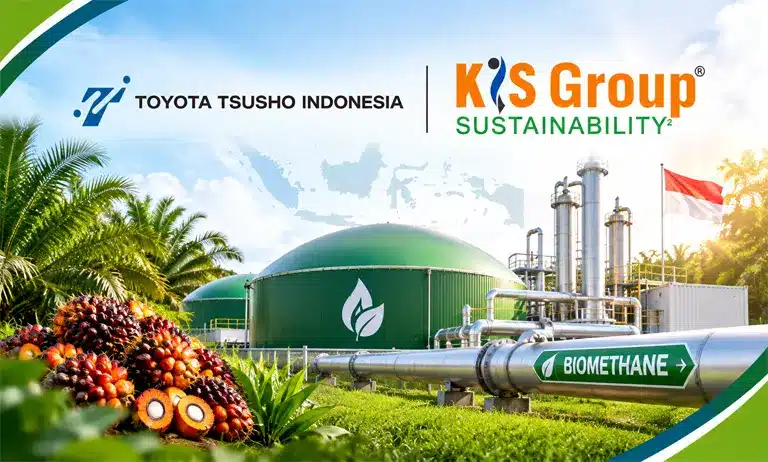
Indonesian Palm Oil News (IPO News) — Indonesia’s palm oil industry is increasingly moving beyond the production of palm oil and into renewable energy. The latest development comes from Toyota Tsusho Corporation and KIS Group, which have established a joint venture to develop a commercial biomethane business in Indonesia.
On October 6, 2026, Toyota Tsusho announced that it had established PT KIS Toyota Tsusho Biomethane Indonesia (KTBI) together with PT KIS Biofuels Indonesia. The joint venture was established in September 2026 and will focus on the production, transportation and sale of biomethane in Indonesia, with its first commercial operations targeted for 2027.
KTBI is owned 51% by PT KIS Biofuels Indonesia and 49% by PT Toyota Tsusho Indonesia. Under this structure, KIS Group becomes the majority shareholder, while Toyota Tsusho contributes its experience and business network in Indonesia, particularly in the manufacturing sector.
Turning Palm Oil Mill Waste into Biomethane
KTBI’s first project will utilise palm oil mill effluent (POME) generated by a palm oil mill in South Sumatra.
Biogas produced from the treatment of POME will be purified into high-quality biomethane. The biomethane will then be transported and sold to industrial customers.
KTBI is targeting annual sales of approximately 150,000 MMBTU of biomethane. The gas is planned to be transported through the pipeline network of PT Perusahaan Gas Negara (PGN) to customers, including manufacturing industries in West Java.
The project therefore creates a new value chain:
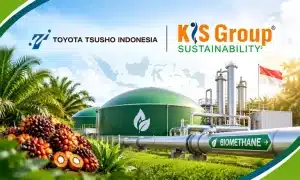
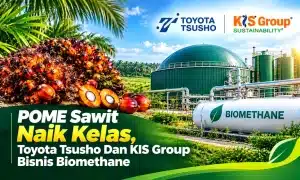
Palm oil mill waste → biogas → biomethane → PGN gas network → manufacturing industry.
This model turns palm oil mill waste from an environmental management challenge into a commercial energy resource.
Connecting Sumatra’s Palm Oil Industry with Java’s Manufacturing Sector
One aspect makes the project particularly significant.
According to Toyota Tsusho, the project will become Indonesia’s first project to supply biomethane produced in Sumatra to customers in Java.
South Sumatra is an important palm oil-producing region, with numerous palm oil mills generating POME. West Java, meanwhile, is one of Indonesia’s major manufacturing centres.
By utilising PGN’s pipeline infrastructure, biomethane can be transported from the palm oil-producing region in Sumatra to industrial customers in Java.
For the palm oil industry, the concept opens a new opportunity to develop an energy business without having to build an entirely new distribution network.
For manufacturers, biomethane offers an alternative lower-carbon energy source that can potentially utilise existing gas infrastructure and equipment, helping limit additional investment requirements on the customer side.
KIS Brings Global Experience
Toyota Tsusho’s entry into Indonesia’s biomethane sector also strengthens KIS Group’s position in renewable energy development.
Toyota Tsusho stated that KIS Group has developed more than 90 biogas projects across more than 20 countries.
PT KIS Biofuels Indonesia is also described as the first company in Indonesia to commercially produce and sell biomethane.
This experience provides the joint venture with an operational and technological foundation beyond a simple pilot project.
Toyota Tsusho Sees Opportunity in Industrial Decarbonisation
For Toyota Tsusho, the biomethane project is also linked to the growing demand from industries seeking to reduce their carbon emissions.
Toyota Tsusho said it intends to combine KIS’s biomethane expertise with its own business network in Indonesia to support the decarbonisation needs of industrial customers, including Japanese companies operating in the country.
Biomethane could complement natural gas while helping industrial users reduce their dependence on fossil fuels.
The project is also planned to pursue International Sustainability and Carbon Certification (ISCC). The certification is expected to strengthen the environmental credentials of the biomethane while potentially increasing its commercial value.
More Than a Single Project
Toyota Tsusho views the South Sumatra project as the first step toward developing biomethane businesses in other regions of Indonesia.
This means the establishment of KTBI is not necessarily limited to a single production facility.
If the initial project performs as planned, the same model could potentially be replicated in other regions with large concentrations of palm oil mills and significant POME resources.
That is where the larger opportunity lies.
Indonesia has thousands of palm oil mills producing wastewater continuously. With the right technology and a viable market, POME could become an important feedstock for renewable energy production.
From CPO to Renewable Energy
The development demonstrates how Indonesia’s palm oil industry is entering a new stage of resource utilisation.
For decades, the industry has focused primarily on CPO, palm kernel, oleochemicals, biodiesel and downstream palm-based products. The conversion of POME into biomethane now opens another potential business stream.
Under the Toyota Tsusho–KIS Group model, economic value is generated not only from the palm fruit, but also from the waste produced during processing.
If the model can be successfully expanded on a commercial scale, palm oil mills could become an increasingly important part of Indonesia’s renewable energy ecosystem.
For Indonesia, the benefits extend beyond the palm oil industry itself. The project connects plantations, renewable energy, gas infrastructure and manufacturing within a single value chain.
For KIS Group and Toyota Tsusho, meanwhile, the establishment of KTBI represents an important step toward scaling up Indonesia’s biomethane industry.
From palm oil mill waste in South Sumatra to energy for industries in West Java, this emerging value chain demonstrates that the future of Indonesia’s palm oil industry may lie not only in the oil it produces, but also in the energy that can be generated from its processing waste.
To subscribe or for more information, contact: Marketing Or Email
Need a research report? Please visit CDMI Consulting