From Palm Oil Mill Waste to Energy, Opening a New Chapter in Palm Oil Downstreaming
Indonesian Palm Oil News (IPO News) — For decades, Palm Oil Mill Effluent (POME), or wastewater generated by palm oil mills, has primarily been viewed as an environmental challenge that needs to be properly managed. That perspective is now beginning to change. POME is increasingly being viewed not merely as waste, but as a feedstock for renewable energy with commercial value.
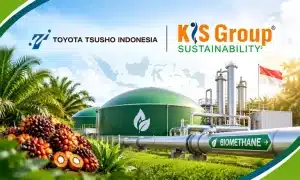
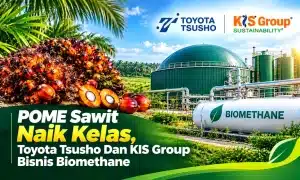
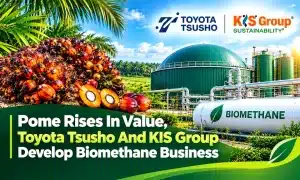
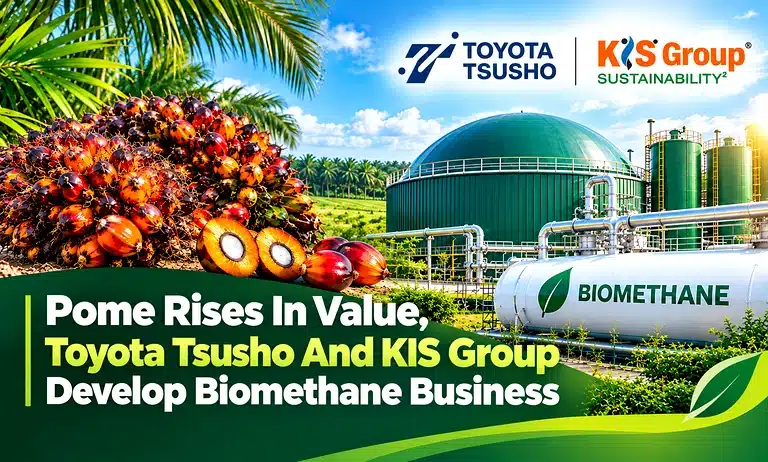
This shift is becoming increasingly visible as Toyota Tsusho Indonesia partners with PT KIS Biofuels Indonesia to develop a biomethane business based on POME in Indonesia. The two companies established a joint venture, PT KIS Toyota Tsusho Biomethane Indonesia (KTBI), in September 2026. The company is owned 51% by PT KIS Biofuels Indonesia and 49% by Toyota Tsusho Indonesia.
Its first project is located in South Sumatra and is targeted to begin commercial operations in 2027. The facility will process biogas generated from POME and upgrade it into high-quality biomethane, with a targeted sales volume of approximately 150,000 MMBTU per year. What makes the project significant is not simply its production capacity. More importantly, it represents a new business model.
Palm Mill Waste Enters the Energy Business
During palm oil processing, POME contains organic matter that can generate biogas. This gas contains methane, which can be captured and purified. Through an upgrading process, the biogas can be converted into biomethane. Biomethane has characteristics that allow it to be used in existing gas based equipment. Industrial customers therefore do not necessarily need to replace their entire energy systems.
This is where the economic value begins to change. POME, which previously required treatment and management to meet environmental requirements, can potentially become a commercial energy product. For palm oil companies, this could change the way wastewater treatment facilities are viewed. They could increasingly become part of an energy related business unit.
PGN Connects Biomethane to the Industrial Market
The South Sumatra project becomes even more interesting because the biomethane produced will not be limited to local consumption. PT Perusahaan Gas Negara (PGN) will play a role in the business chain. The biomethane is planned to be transported through PGN’s pipeline network to industrial customers in West Java.
Toyota Tsusho describes the project as the first project in Indonesia designed to supply biomethane produced in Sumatra to customers on Java. This connects two regions with very different characteristics. Sumatra has a large concentration of palm oil mills and POME feedstock, while Java has a high concentration of manufacturing industries and energy demand.
PGN’s gas infrastructure provides the connection between them, in the biomethane business model, allowing the renewable gas to enter a broader energy supply chain.
150,000 MMBTU: How Large Is It?
The targeted annual volume of approximately 150,000 MMBTU may appear modest compared with Indonesia’s overall energy demand. However, its strategic importance lies in the fact that it is an early commercial project. Toyota Tsusho states that 52 MMBTU is equivalent to approximately one tonne of LNG on an energy basis. Using that conversion, 150,000 MMBTU is roughly equivalent to 2,885 tonnes of LNG in energy terms.
This does not mean the biomethane will be sold as LNG. The comparison is simply intended to illustrate the energy scale of the project. The more important question is whether this model can be replicated. Indonesia has a very large palm oil industry and thousands of palm oil mills producing POME continuously. If one project can successfully convert POME into a commercially marketable energy product, more mills could potentially become sources of biomethane.
The National Potential Is Far Greater
Data from PGN provide an interesting perspective, In its sustainability reporting, PGN previously estimated Indonesia’s palm oil waste could have the potential to generate approximately 195 MMSCFD of methane across various regions.
PGN has also identified Sumatra as one of the initial areas for biomethane development because of its concentration of palm oil mills and existing gas infrastructure. The 195 MMSCFD figure should not be interpreted as immediately available commercial production. Actual development would depend on investment, technology, POME availability, pipeline access, gas quality, customers and project economics.
But the figure demonstrates one important point:
The underlying feedstock potential is substantial. For this reason, the 150,000 MMBTU-per-year project in South Sumatra can be viewed not simply as an individual project, but as an early commercial model for developing a broader POME-based biomethane industry.
KIS Brings Experience, Toyota Tsusho Brings Global Business Reach
The partnership is also significant from the perspective of the companies involved. PT KIS Biofuels Indonesia is part of KIS Group, which operates in biogas and biomethane. Toyota Tsusho says KIS Group has implemented more than 90 biogas projects in more than 20 countries. KIS is also described as having experience in commercial biomethane production and sales in Indonesia.
Toyota Tsusho, meanwhile, brings an extensive business network and industrial customer base in Indonesia, including Japanese companies. This combination is important because biomethane development requires more than technology. It requires feedstock, processing facilities, customers, transportation infrastructure, quality standards and a viable commercial model. The South Sumatra project brings these elements together within one ecosystem.
More Than Energy: Environmental Value
There is another reason why POME-based biomethane is attracting attention. POME naturally generates methane. If that methane is not captured and utilized, it can be released into the atmosphere. By capturing the biogas and upgrading it into biomethane, the project can provide two benefits: reducing methane emissions from palm oil waste while replacing part of the use of fossil-based gas.
Toyota Tsusho also states that KTBI plans to pursue ISCC certification, which could strengthen international recognition of the sustainability attributes of the biomethane produced. This means the future value of a biomethane project may not depend solely on the volume of gas sold. It could also include value associated with decarbonization and sustainability.
Could Palm Oil Mills Become Energy Producers?
This is an important question for the palm oil industry. Traditionally, the core business of a palm oil mill has been processing fresh fruit bunches into CPO and other products. But technological development is gradually expanding the potential revenue streams from a mill.
Fresh fruit bunches produce CPO and palm kernels. Palm kernels can enter the palm kernel oil and feed industries. Fiber and shells have long been used as boiler fuel. Now, POME is entering the discussion as a potential source of commercial renewable energy.
If biomethane projects prove economically viable, palm oil companies may have a stronger incentive to invest in POME processing—not only because of environmental obligations, but because the process could generate additional energy revenue.
A New Chapter in Palm Oil Downstreaming
For years, palm oil downstreaming has largely focused on increasing the value of CPO through cooking oil, oleochemicals, biodiesel, oleofood and other downstream products.
Now, the concept is expanding.
Waste is entering the value chain.
The South Sumatra biomethane project demonstrates that the future of the palm oil industry may not be determined solely by how much CPO it produces, but also by how much economic value can be extracted from every part of the palm oil processing chain including its waste.
If the project achieves commercial operations in 2027 and the model is subsequently replicated at more palm oil mills, Indonesia could develop a new industry connecting palm oil plantations, biogas technology, the energy sector, gas infrastructure and manufacturing.
At that point, POME will no longer be viewed simply as waste.
POME will have risen to become an energy feedstock.
And for Indonesia’s palm oil industry, the next question is no longer whether POME can be utilized.
The question is:
How much business value can be created from POME when its full potential is developed commercially?
To subscribe or for more information, contact: Marketing Or Email
Need a research report? Please visit CDMI Consulting