More than 3 million smallholders account for 30% of global palm oil supply. Strengthening institutions, knowledge, and market access is essential to expanding sustainable plantation practices
Indonesian Palm Oil News (IPO News), Bangkok — The role of independent smallholders has become an important consideration in discussions about the future of sustainable palm oil production at the international level. The World Trade Organization (WTO) Chair Programme Indonesia at Universitas Gadjah Mada (UGM), through its Center for World Trade Studies (CWTS), has highlighted the need to strengthen smallholders’ capacity to participate more effectively in global palm oil supply chains and secure greater economic benefits.
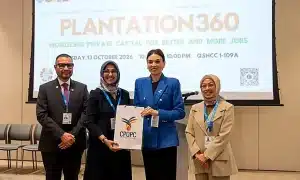
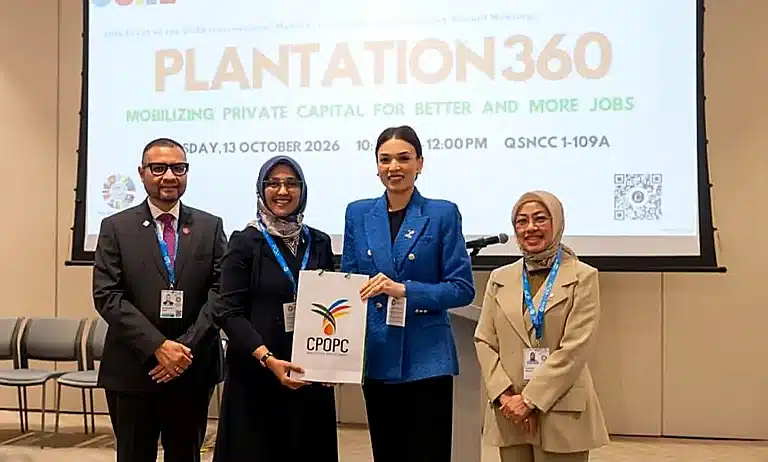
The issue was raised by Dr. Maharani Hapsari, S.IP., MA., Director of CWTS UGM and Chairholder of the WTO Chair Programme Indonesia, who participated as a panellist at the seminar “Plantation 360: Mobilizing Private Capital for More and Better Jobs” at the Queen Sirikit National Convention Center in Bangkok, Thailand, on 13 October 2026.
The seminar was part of the side events accompanying the 2026 Annual Meetings of the International Monetary Fund (IMF) and the World Bank Group, held in Bangkok from 12 to 18 October. It was organised by the World Bank Group’s Office of the Executive Director for the Southeast Asia Constituency (EDS16), in collaboration with the Council of Palm Oil Producing Countries (CPOPC).
The forum examined the potential of plantation industries to create jobs, improve rural livelihoods, and strengthen economic resilience. In the palm oil sector, smallholder participation is particularly important because the industry’s sustainability depends not only on plantation companies’ productivity but also on smallholders’ ability to meet evolving market requirements.
CERTIFICATION GAP UNDER SCRUTINY
In her presentation, Maharani highlighted the gap between smallholders’ substantial contribution to global palm oil supply and their level of participation in sustainability certification schemes.
According to figures presented at the forum, more than 3 million smallholders produce approximately 30% of the world’s palm oil supply. However, only around 2% of the supply produced by this group is covered by sustainability certification, as reported by UGM.
This situation illustrates that smallholders’ contribution to the global palm oil industry has not yet been matched by sufficient capacity to meet sustainability requirements that are increasingly important in international markets.
Maharani described smallholders as a key social pillar of the future palm oil industry. However, without adequate support, they risk being left behind as market requirements continue to evolve.
The challenges extend beyond agricultural practices. Limited knowledge, institutional capacity, technical assistance, and access to market information can also constrain smallholders’ ability to improve plantation management and strengthen their competitiveness.
GLOBAL REGULATIONS AND MARKET ACCESS
One of the challenges highlighted was the potential impact of the European Union Deforestation Regulation (EUDR) on smallholders and their families.
Increasingly complex market requirements can place additional burdens on farmers who lack the resources and capacity to comply with sustainability and product traceability requirements. Administrative complexity may also restrict their access to international markets.
Meanwhile, public support for research, knowledge development, and cooperation among smallholder organisations needs to be strengthened. The transition from labour-intensive production systems towards greater technology adoption also presents challenges in attracting and retaining younger generations in the plantation sector.
Strengthening smallholders’ competitiveness therefore requires a comprehensive approach. Improving plantation productivity must go hand in hand with stronger farmer organisations, a better understanding of sustainability standards, and broader market access.
COOPERATIVES OFFER A SUCCESSFUL MODEL
As an example of successful implementation, Maharani highlighted Koperasi Tani Subur, a smallholder cooperative in West Kotawaringin Regency, Central Kalimantan.
The cooperative has 1,639 members and has held Indonesian Sustainable Palm Oil (ISPO) and Roundtable on Sustainable Palm Oil (RSPO) certifications since 2017.
It manages 1,460.84 hectares of RSPO-certified plantations and operates nine business units, including savings and loans and agro-tourism. Its agro-tourism business reportedly attracts approximately 139,000 visitors annually.
In addition to developing supporting businesses, the cooperative uses the oil palm replanting period to cultivate maize and raise chickens. These initiatives provide examples of business diversification intended to support members’ income while their plantations undergo replanting.
Koperasi Tani Subur’s experience demonstrates how stronger institutions can help smallholders expand beyond fresh fruit bunch (FFB) production. Cooperatives can also provide a platform for developing complementary economic activities, improving access to financing, and strengthening compliance with sustainability standards.
INVESTING IN SMALLHOLDER KNOWLEDGE AND INSTITUTIONS
Maharani called for a shift from purely technical assistance towards a more structural approach, particularly through investment in human resources and smallholders’ knowledge.
Farmers need opportunities to organise themselves, have their local knowledge recognised, and participate meaningfully in discussions on sustainability standards, including at international forums.
This approach is important to ensure that smallholders are not merely raw material suppliers. They must also have the capacity to understand market developments, improve plantation practices, and participate in decision-making processes that affect their businesses.
For Indonesia’s palm oil industry, strengthening independent smallholders is an essential part of building a more sustainable supply chain. Collaboration among the government, plantation companies, research institutions, farmer organisations, cooperatives, and certification bodies is needed to ensure that higher sustainability standards go hand in hand with stronger smallholder livelihoods.
With the right support, smallholders can improve productivity, expand access to markets requiring sustainability certification, and strengthen their contribution to the global competitiveness of Indonesian palm oil.
Source: Universitas Gadjah Mada (UGM) and the Center for World Trade Studies (CWTS UGM), 22 October 2026.
Muslim M. Amin, Editor in Chief
To subscribe or for more information, contact: Marketing Or Email
Need a research report? Please visit CDMI Consulting