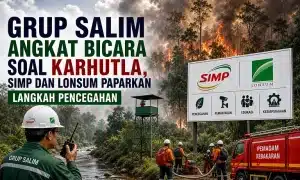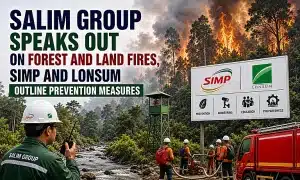
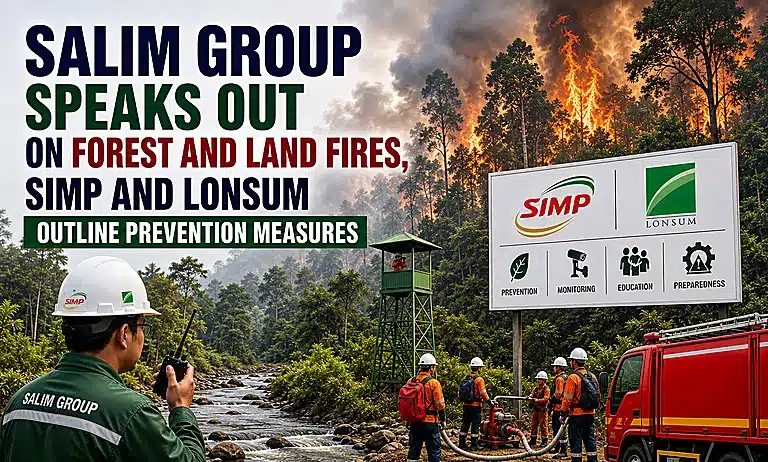
The two listed palm oil companies reaffirm their commitment to a zero burning policy, satellite based hotspot monitoring, and firefighting preparedness to mitigate the risk of forest and land fires
Indonesian Palm Oil News (IPO News), Jakarta — Salim Group, through its two publicly listed palm oil plantation companies, PT Salim Ivomas Pratama Tbk (SIMP) and PT PP London Sumatra Indonesia Tbk (Lonsum/LSIP), has issued statements regarding the forest and land fires occurring in Indonesia in 2026.
Both companies provided explanations to the Indonesia Stock Exchange (IDX) concerning the impact of the fires on their operations and business continuity. In their respective statements, management said that, as of the reporting dates, the fires had not had a material impact on their business operations or business continuity.
The statements have drawn attention amid heightened fire risks during the dry season and growing emphasis on fire prevention in plantation areas. For large scale palm oil companies, managing fire risks is not only essential to protecting assets and maintaining production, but also to ensuring environmental compliance and preserving stakeholder confidence.
SIMP Relies on Satellite Monitoring
PT Salim Ivomas Pratama Tbk explained that it consistently implements a zero burning policy across its plantation operations. Instead of using fire to clear unproductive land, the company employs mechanical methods for land preparation.
SIMP’s Corporate Secretary, Meyke Ayuningrum, explained that the company also proactively monitors and identifies hotspots. This monitoring uses satellite data from the National Oceanic and Atmospheric Administration (NOAA) and the National Aeronautics and Space Administration (NASA), which are cross checked against the company’s official concession maps.
According to management, hotspots detected sporadically on a small scale within the SIMP Group’s plantation areas can be followed up promptly to prevent them from developing into larger fires. These measures are supported by the provision of firefighting vehicles and equipment, as well as regular training for field personnel. The company also stated that it works with local communities to strengthen fire prevention and response capabilities.
In information reported on October 16, 2026, SIMP stated that, as of October 15, 2026, forest and land fires had not had a material impact on the company’s business operations or business continuity.
Lonsum Implements a No Burning Policy
A similar position was expressed by PT PP London Sumatra Indonesia Tbk (LSIP), another plantation company affiliated with Salim Group. Lonsum’s Corporate Secretary, Fajar Triadi, stated that the company consistently implements a no burning policy. The clearing of unproductive plantation land is carried out using mechanical methods.
Lonsum also monitors and identifies hotspots within its plantation areas. Early detection is important because hotspots that are not addressed promptly may develop into more extensive fires. In addition to monitoring, the company emphasized the importance of maintaining adequate firefighting facilities and infrastructure, as well as implementing fire response procedures in accordance with applicable requirements.
LSIP’s management also stated that the fires had not had a material impact on the company’s operations or business continuity as of the date of its disclosure.
Prevention Is Key to Managing Fire Risks
The statements from SIMP and Lonsum demonstrate that fire prevention is an important component of risk management in the palm oil plantation business. A zero burning policy, hotspot monitoring, firefighting preparedness, and community involvement are among the measures outlined by the two companies.
Satellite data is also an important tool for helping to identify potential fires at an early stage. However, the effectiveness of fire management ultimately depends on appropriate field action, rapid response, and consistent implementation of prevention procedures throughout operational areas.
At the same time, statements that fires have not had a material impact on business operations should be interpreted proportionately. They reflect the companies’ assessments of the impact on their operations and business continuity. Such statements do not, by themselves, constitute independent verification that all plantation areas are free from fires or environmental violations.
Consequently, developments concerning forest and land fires, as well as the implementation of fire prevention policies by plantation companies, remain important matters to monitor through official company disclosures and information from the relevant authorities.
For Indonesia’s palm oil industry, the ability to prevent and respond rapidly to fires is an important element of business sustainability. Amid continued scrutiny of environmental issues, transparent disclosure and consistent implementation of zero-burning policies are also factors that can influence public confidence in plantation companies.
Muslim M. Amin, Editor in Chief
To subscribe or for more information, contact: Marketing Or Email
Need a research report? Please visit CDMI Consulting