Indonesian Palm Oil News (IPO News), Bali — Chairman of the Indonesian Palm Oil Association (GAPKI), Eddy Martono, stated that Indonesia’s palm oil production is fundamentally sufficient to support the implementation of the B50 biodiesel program. However, increasing domestic palm oil absorption for energy could put significant pressure on export volumes unless productivity growth is accelerated.
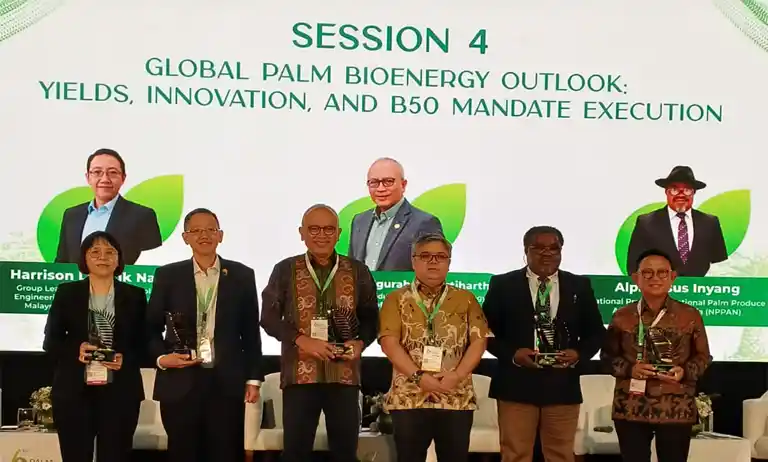
Eddy delivered the statement during the session “Global Palm Bioenergy Outlook: Yields, Innovation, and B50 Mandate Execution” at the 6th Palm Biodiesel Conference 2026 in Nusa Dua, Bali, on Friday, September 18, 2026.
According to Eddy, Indonesia’s current palm oil supply is fundamentally sufficient to support B50. However, greater domestic absorption for biodiesel will reduce the volume of palm oil available for export. The pressure is expected to become more pronounced in 2027 as production is projected to decline while domestic demand continues to increase.

2026 Production Projected at 58.8 Million Tons
In his presentation, Eddy projected Indonesia’s combined crude palm oil (CPO) and palm kernel oil (PKO) production at 58.8 million tons in 2026.
Domestic consumption is projected at approximately 27.1 million tons, while exports are expected to reach around 31.1 million tons.
These figures highlight the continued importance of export markets in absorbing Indonesia’s palm oil production. However, increasing domestic demand for biodiesel is expected to gradually change this balance.
Eddy noted that while the supply fundamentals remain sufficient to support B50, the greater the volume allocated to biodiesel, the smaller the amount available for export.
2027: Lower Production, Higher Domestic Demand
The challenge is expected to become more significant in 2027.
Indonesia’s combined CPO and PKO production is projected to decline to approximately 56.6 million tons, partly due to weather-related factors.
At the same time, domestic consumption is expected to rise to 30.2 million tons.
Biodiesel consumption alone is projected to increase by 18.4% to 17.4 million tons.
The combination of lower production and higher domestic absorption will further reduce export availability. Palm oil exports are projected to decline from 31.1 million tons in 2026 to 26.4 million tons in 2027.
This represents a potential decline of approximately 4.7 million tons, or nearly 5 million tons, equivalent to around 14.87% year-on-year.
B50 Is More Than a Biodiesel Issue
Eddy’s presentation highlighted that B50 is not merely a question of biodiesel production capacity.
The policy is directly connected to the balance between domestic food demand, energy security, industrial requirements, exports, and government revenues.
A significant decline in export volumes could also affect government revenues from taxes and export levies. According to Eddy, these revenues have played an important role in supporting the sustainability of Indonesia’s biofuel industry.
This makes productivity improvement increasingly important as Indonesia expands the use of palm oil for domestic energy.
Smallholder Productivity Holds the Key
To maintain a balance between domestic food requirements, biofuel demand and export performance, Eddy emphasized the importance of increasing productivity rather than expanding plantations into primary forests.
The focus should be placed on improving productivity on existing plantation areas, particularly those managed by smallholders.
This can include replanting, the use of high-quality planting materials, improved cultivation practices, and better access to technology and agricultural inputs.
Productivity has long been identified as one of the structural challenges facing Indonesia’s upstream palm oil sector. A study supported by BPDP has also highlighted stagnant upstream productivity as an important factor that could constrain future production growth, reinforcing the need for productivity improvements and more efficient use of existing land.
Balancing Three Strategic Interests
Indonesia now faces the challenge of balancing three major interests: food security, energy security and export performance.
The B50 program will increase the proportion of palm oil absorbed domestically for energy. This strengthens the utilization of domestic resources and supports the country’s energy-security objectives.
At the same time, palm oil exports remain an important source of foreign exchange for Indonesia.
For this reason, productivity improvement could become one of the most important factors in maintaining this balance. Higher productivity from existing plantations would provide greater room for Indonesia to meet domestic energy demand while maintaining export capacity.
Eddy Martono’s message at the biodiesel conference was clear: Indonesia has the fundamental supply capacity to support B50, but the long-term sustainability of the program will depend heavily on the country’s ability to increase palm oil productivity.
Higher productivity would give Indonesia greater room to meet domestic energy requirements while maintaining its position as a major palm oil exporter. Conversely, if production remains stagnant while biodiesel demand continues to rise, pressure on export volumes could become increasingly significant.
To subscribe or for more information, contact: Marketing Or Email
Need a research report? Please visit CDMI Consulting