Indonesian Palm Oil News (IPO News), Merauke — Palm oil mill effluent (POME) is no longer simply an environmental challenge. With the right processing technology, this wastewater can be converted into a renewable energy source that delivers direct benefits to industrial operations.
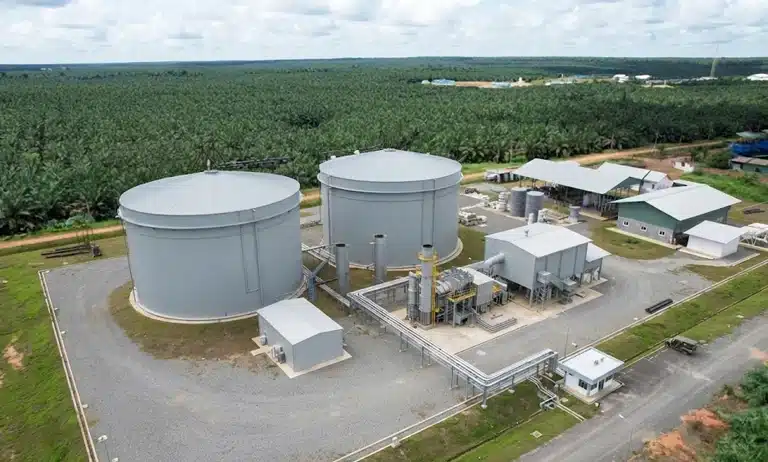
This breakthrough has been implemented by Tunas Sawa Erma (TSE) Group through its subsidiary, PT Berkat Cipta Abadi (BCA), with the development of a Biogas Power Plant (PLTBg) and Compressed Biomethane Gas (CBG) facility, officially inaugurated on August 1, 2025, in South Papua.
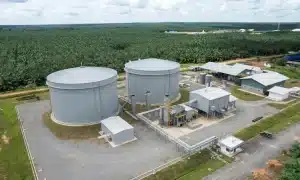
The project represents TSE Group’s first inaugurated renewable energy facility in Papua that utilizes palm oil waste. The facility is designed to process approximately 1,000 cubic meters of POME per day into biogas and energy.
SYNERGY BETWEEN TSE GROUP AND KIS GROUP
One of the key aspects of this project is the involvement of KIS Group as a technology and implementation partner in developing POME-to-biogas and BioCNG solutions. KIS Group has experience in waste to energy, biogas and BioCNG technologies, with projects in several countries. Its official portfolio also lists PT Berkat Cipta Abadi in Papua, with a POME processing capacity of approximately 1,000 cubic meters per day.
The collaboration demonstrates how a palm oil plantation company and a renewable energy technology company can work together to transform palm oil waste into an economically valuable energy resource.
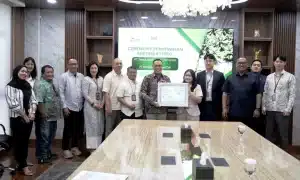
Information regarding KIS Group’s involvement is also consistent with the statement provided by Ms. Yasmin, Commissioner of KIS Group, regarding KIS Group’s collaboration in the project.
USD 3.6 MILLION INVESTMENT
TSE Group allocated approximately USD 3.6 million for the development of the facility, The plant is equipped with two biogas tanks, each with a capacity of approximately 7,800 cubic meters. Methane generated from the POME treatment process is then utilized as fuel to generate electricity.
TSE Group stated that the facility has a generation capacity of approximately 2 MW, supporting the operational requirements of the Palm Kernel Crushing Plant (KCP) and other facilities. Meanwhile, surplus methane is processed into Compressed Biomethane Gas (CBG), which can be used as an alternative fuel to replace diesel in gensets.
POTENTIAL TO REDUCE 60,708 TONS OF CO₂ EMISSIONS
From an environmental perspective, the project provides significant potential benefits. TSE Group estimates that the facility could reduce greenhouse-gas emissions by approximately 60,708 tons of CO₂ per year. The utilization of CBG is also expected to help reduce diesel consumption in the company’s operations.
Before the biogas facility was developed, POME generated from palm oil processing had to be managed through wastewater treatment systems. Through biogas technology, the organic content of POME can instead be utilized by anaerobic bacteria to produce methane.
The methane is then treated and purified before being used to generate electricity or further processed into CBG.
FROM WASTE TO ENERGY
TSE Group Director Luwy Leunufna previously explained that the initial investment required to develop a biogas facility is relatively significant. However, in the long term, the technology can help reduce the company’s dependence on fossil fuels across plantation and mill operations.
According to Luwy, integrating a Biogas Power Plant with BioCNG can provide benefits for both the company and the environment.
TSE Group President Commissioner Robert Seung also stated that the facility forms part of the company’s vision to develop a palm oil industry that is sustainable, efficient, environmentally responsible and beneficial to surrounding communities.
A MODEL WITH POTENTIAL FOR FURTHER DEVELOPMENT
What makes the TSE Group project particularly interesting is the company’s plan to expand beyond a single location.
TSE Group has stated that it plans to develop similar facilities at five other operating units, while continuing other green-energy initiatives, including electric vehicles, solar power and emission-reduction programs.
According to data from Indonesian Palm Oil News (IPO NEWS), the development of POME-to-biogas and BioCNG technology demonstrates that palm oil waste is becoming increasingly strategic within the palm oil industry value chain.
The collaboration between TSE Group and KIS Group provides an example of how investment in technology is not only about reducing waste and emissions, but also about improving energy efficiency, reducing dependence on fossil fuels and creating additional value from palm oil waste.
For Indonesia’s palm oil industry, this approach opens up the possibility that palm oil mills in the future will not only produce CPO and palm kernel, but can also become an integral part of a renewable-energy ecosystem based on palm oil waste.
To subscribe or for more information, contact: Marketing Or Email
Need a research report? Please visit CDMI Consulting