Indonesian Palm Oil News (IPO News), Jakarta — Indonesia’s palm oil industry plays a strategic role not only in the national economy, but also in supporting the livelihoods of millions of smallholders and communities whose lives depend on the sector. Strengthening the supply chain, ensuring the availability of cooking oil, improving productivity, and enhancing smallholder welfare are therefore important elements in the industry’s future development.
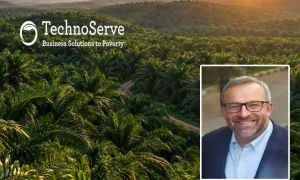
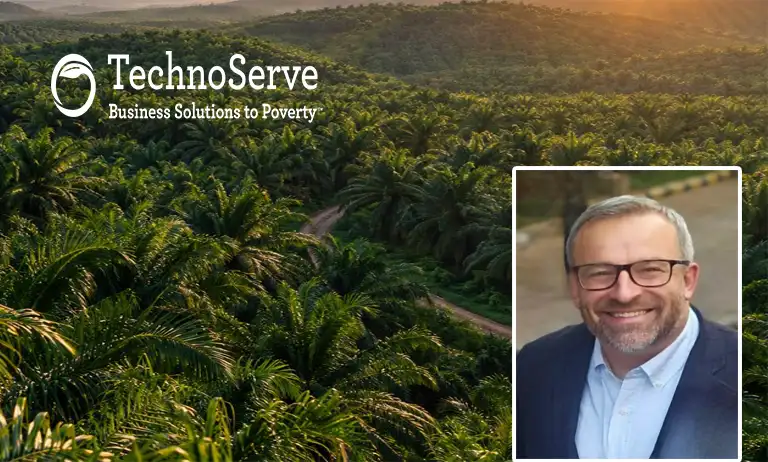
To gain a broader perspective on these issues, IPO NEWS conducted an interview with Dominic Schofield, Senior Director, Agri-Food Systems, TechnoServe.
In the interview, Dominic Schofield provided clear, insightful, and comprehensive responses on various important aspects of Indonesia’s palm oil industry, including its challenges and opportunities going forward.
Here are his views and insights shared with IPO NEWS:
Q: TechnoServe has experience supporting agribusiness development and smallholder income growth in various countries. How does TechnoServe view the current development and challenges in Indonesia’s agribusiness sector?
A: TechnoServe sees Indonesia’s agribusiness sector at a critical structural transition. According to the 2023 Agricultural Census, 60.8% of the country’s 29.3 million agricultural holdings are under 0.5 hectares, and only 1 in 5 farmers are millennials (19–39 years old)—highlighting severe constraints in farm consolidation, productivity, and generational renewal.
Addressing these challenges, along with climate vulnerability and limited access to finance and reliable markets, isn’t just about introducing technology. It requires building the commercial conditions for adoption—strengthening farmer organizations, aggregators, business services, and links to remunerative buyers.
Simultaneously, major demand drivers are emerging. National drives for rice self-sufficiency, agricultural downstreaming, higher-value exports, and the Free Nutritious Meals (MBG) program are reshaping value chains and creating massive institutional demand. Indonesia’s key opportunity is leveraging these shifts to build private-sector-led market systems that drive broad-based smallholder income growth, boost productivity, and make agriculture commercially viable for the next generation.
Q: Palm oil is one of the crucial commodities in Indonesian agribusiness. How does TechnoServe view palm oil’s position in the vegetable oil supply chain, particularly in meeting the needs of the cooking oil industry?
A: TechnoServe sees palm oil as strategic to Indonesia’s food security, rural incomes, and broader bioeconomy. In 2024, Indonesia produced 45.4 million tonnes of CPO across 16.8 million hectares, with smallholders managing about 41% of total plantation area. Because palm oil satisfies over 95% of domestic cooking oil needs, keeping it affordable is vital for lower-income consumers.
However, the primary growth opportunity lies in driving value from existing land rather than expanding the agricultural frontier. Replanting aging smallholder plots, upgrading yields, strengthening climate resilience, and enhancing access to finance, farmer services, and quality planting material will simultaneously boost smallholder livelihoods, domestic food security, and environmental outcomes.
Innovation across both cultivation and processing is equally critical. Efficient, low-carbon production and milling—leveraging biomass and waste—reduces resource intensity. Downstream processing can further transform palm oil and its fractions into high-value food ingredients, oleochemicals, and specialty fats instead of relying predominantly on bulk oil or fuel. Furthermore, fortifying palm oil with vitamin A and essential micronutrients through its massive domestic distribution network offers a direct, widespread vehicle to tackle micronutrient deficiencies.
Ultimately, the goal is capturing more value per hectare: higher smallholder productivity and incomes, lower-carbon operations, high-value derivative production, and improved nutritional outcomes for Indonesian consumers.
Q: How does TechnoServe view the current development of Indonesia’s cooking oil industry, especially regarding raw material availability and consumer demand?
A: Over the past decade, Indonesia’s palm oil production expanded from 30–35 million MT to over 45 million MT, playing a pivotal role in safeguarding domestic food security and supplying the Global South. However, new demand policies—specifically the B-50 biodiesel mandate—are tightening raw material availability, with GAPKI estimating it could divert 4 million MT annually from food uses. Additionally, routing commodity exports through the state entity PT Danantara Sumberdaya Indonesia (DSI) introduces operational changes for exporters.
To protect domestic consumers and stabilize supply, the government launched the Minyakita packaged oil brand tied to export performance requirements. This policy not only secures domestic cooking oil access and stabilizes prices, but also accelerates the transition from loose to packaged oil—enhancing hygiene standards and delivering Vitamin A fortification to address micronutrient deficiencies.
Q: In the palm oil supply chain—from smallholders, Fresh Fruit Bunch (FFB) collection, palm oil mills (POM), refineries, to cooking oil products reaching consumers—where does TechnoServe see the largest issues that need fixing, and what is the most effective solution to address them?
A: TechnoServe sees the critical bottleneck at the smallholder-to-mill interface. While Indonesia’s commercial palm sector is highly efficient, independent smallholders—who manage 41% of the national plantation area (6.94 million hectares) across 2.9 million farmers—suffer from low yields and weak access to finance, technology, and formal markets.
To address this without relying on land expansion, TechnoServe advocates for an integrated smallholder commercialization model focused on three interventions:
- Farmer Aggregation and Direct Market Linkages: Build market-driven cooperatives that aggregate Fresh Fruit Bunches (FFB), improve harvest scheduling, provide business services, and negotiate directly with mills—cutting out inefficient intermediaries and boosting FFB quality.
- Digital Farm-Level Traceability: Map plots digitally to link farmers directly to supply chains. This eliminates origin loss during aggregation, helping farmers meet mandatory ISPO and international market requirements (e.g., e-STDB).
- Productivity, Sustainability, and Finance Alignment: Use farmer organizations as platforms to distribute high-yield certified seeds, train on Good Agricultural Practices (GAP), and unlock replanting finance—vital given that Indonesia’s smallholder replanting program has met less than half of its national target.
By organizing smallholders and connecting them directly and transparently to mills, this approach increases farmer incomes, secures traceable supply for processors, and enhances the entire value chain’s competitiveness.
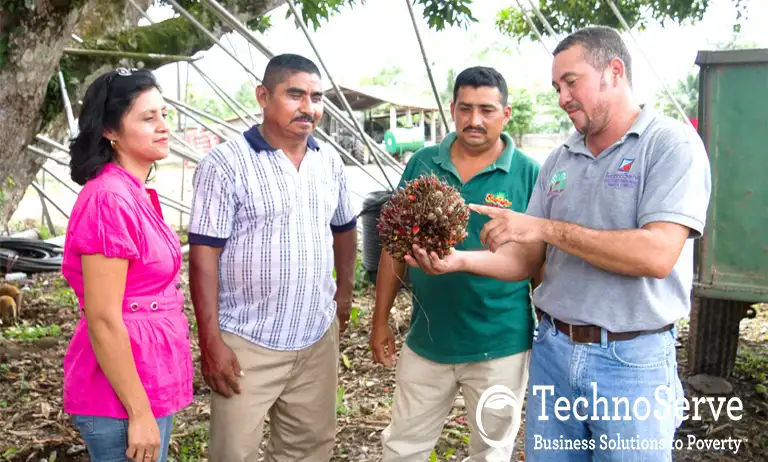
Q: How can we ensure that supply chain improvements not only increase corporate efficiency but also deliver greater economic benefits to palm oil smallholders?
A: TechnoServe believes supply-chain efficiency must be designed to maximize value captured by smallholders, rather than simply reducing costs for downstream companies—an essential focus given that 2.9 million farmers manage ~41% of Indonesia’s 16.83 million hectares of oil palm.
To ensure efficiency gains deliver direct economic benefits, three principles are critical:
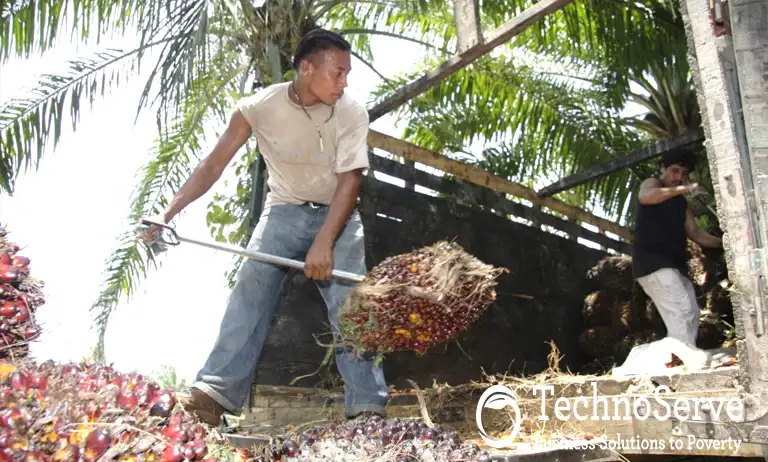
- Boost Productivity and Lower Costs: Raising current smallholder FFB yields (which average around 3 tonnes/ha) through high-quality planting material, agronomic extension, replanting finance, mechanization, and digital advisory significantly improves farm-level margins.
- Strengthen Farmers’ Bargaining Power: Well-governed farmer cooperatives aggregate volume, optimize logistics, negotiate directly with mills, and secure financial services at scale. Introducing digital weighing, quality scoring, transparent pricing, and traceability reduces information asymmetry, ensuring efficiency gains reflect directly in farmer payouts.
- Expand Value Creation Beyond Raw FFB: Structuring commercially viable partnerships allows farmer organizations to participate in aggregation, transport, processing, sustainability certification, and downstream activities.
Ultimately, supply-chain partnerships must be evaluated on measurable farmer metrics—higher net income per hectare, lower transaction costs, and better financial resilience—rather than just mill supply volume.
Q: Indonesia is one of the world’s largest Crude Palm Oil (CPO) producers, yet cooking oil prices at the consumer level remain a major concern. According to TechnoServe, what are the primary factors driving this issue?
A: TechnoServe views consumer cooking oil prices as a reflection of interconnected global market dynamics, policy shifts, and supply competition. As the world’s leading CPO producer, Indonesia’s domestic market remains intrinsically linked to global trade; recent geopolitical shocks and supply chain disruptions have driven up international vegetable oil benchmarks, exerting upward pressure on local retail prices.
Domestically, this pressure is heightened by expanding bioenergy mandates—specifically the transition from B-40 to B-50 biodiesel—which diverts substantial CPO volume away from food production and tightens raw material availability for cooking oil refiners. Balancing these bioeconomy ambitions with affordable access for domestic consumers, particularly lower-income households, requires managing competing demands across the CPO value chain to ensure price stability without compromising food security.
Q: How critical is the role of smallholder palm oil farmers in maintaining a sustainable supply of raw materials for Indonesia’s cooking oil industry?
Answer: TechnoServe views smallholder palm oil farmers as indispensable to the long-term security, resilience, and sustainability of Indonesia’s cooking oil supply. Controlling 6.74 million hectares—or roughly 41% of the national oil palm area—smallholders constitute too vast a share of the production base to be treated as peripheral.
Because smallholder yields remain well below those of commercial estates, boosting smallholder productivity presents the single largest opportunity to secure additional CPO supply for domestic food needs without expanding the agricultural frontier. Policy initiatives like the Peremajaan Sawit Rakyat (PSR) replanting program, fertilizer support, ISPO certification, and digital registration (e-STDB) demonstrate growing institutional alignment, but these must be rendered commercially effective on the ground.
The key is fully integrating smallholders into transparent, market-driven value chains. Rather than supporting farmers in isolation, TechnoServe advocates an integrated approach: aggregating smallholders into cooperatives, raising FFB quality, establishing direct off-take agreements with mills, and leveraging farm-level traceability to unlock access to finance and sustainability investments.
Ultimately, this is a shared-value proposition. Highly productive smallholders yield a stable, traceable FFB supply for processors and refiners, safeguarding affordable cooking oil for Indonesian consumers while generating sustainable, higher net incomes for rural households.
Q: According to TechnoServe, what steps must be taken so that Indonesia’s palm oil industry not only leads globally in CPO production, but also creates a cooking oil value chain that delivers greater benefits to smallholders and domestic consumers?
A: TechnoServe believes Indonesia can become a global benchmark not only for raw CPO production, but for maximizing total value per hectare for smallholders and consumers alike. In 2024, Indonesia produced 45.44 million tonnes of CPO across 16.83 million hectares, with smallholders managing 41% of land and supporting over 3 million households.
To turn this scale into shared prosperity, four strategic priorities are essential:
- Transform Smallholders into Bankable Commercial Partners: Organize smallholders into well-governed cooperatives or Farmer Producer Companies (FPCs) that aggregate FFB, secure agronomic inputs, and negotiate directly with mills. This strengthens—rather than operates in isolation from—national programs like Peremajaan Sawit Rakyat (PSR).
- Build Transparent, Digitally Enabled Supply Chains: Deploy farm-level mapping, digital weighing, and batch-level traceability from collection points to refineries. This eliminates information asymmetry, ensures fair pricing, and positions Indonesian palm oil to comply with increasingly rigorous international sustainability regulations.
- Capture High-Value Downstream Innovation: Move beyond bulk CPO and crude cooking oil toward specialty fats, oleochemicals, micronutrient extraction, and bio-based derivatives. Improving processing efficiency and utilizing palm biomass/residues creates higher-margin export markets without expanding land use.
- Deliver Nutritional and Consumer Value Nationally: Leverage the massive domestic distribution footprint of cooking oil to improve public health. Ensuring stable, hygienic supplies of packaged oil—such as MinyaKita for low-income households—combined with mandatory Vitamin A fortification, turns an everyday staple into a powerful vehicle for public health and food security.
Ultimately, the goal is “more value from every hectare”: raising smallholder margins, accelerating low-carbon downstream industrialization, and providing affordable, nutritious cooking oil to Indonesian families.
Founded in 1968, TechnoServe is a leader in harnessing the power of the private sector to help people lift themselves out of poverty for good. A non-profit organization working in around 20 countries, we work with people to build a better future through regenerative farms, businesses, and markets that increase incomes.
Our vision is a sustainable world where all people in low-income communities have the opportunity to prosper.
For more information:
Twitter @TechnoServe | Facebook @TechnoServe | LinkedIn @TechnoServe
To subscribe or for more information, contact: Marketing Or Email
Need a research report? Please visit CDMI Consulting