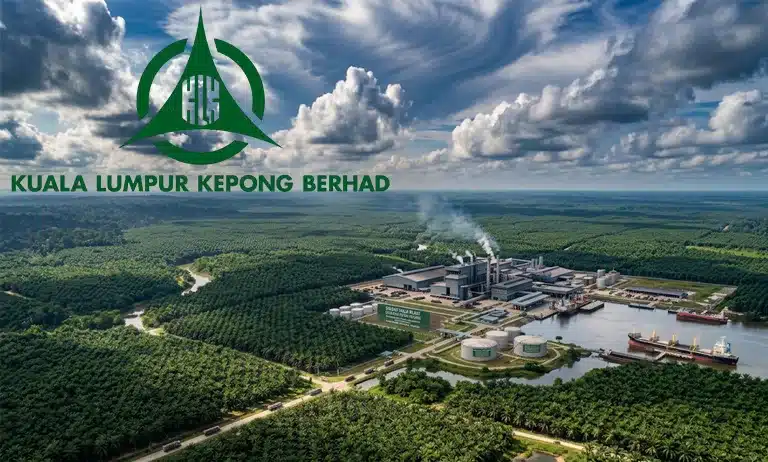
Indonesian Palm Oil News (IPO News) — Kuala Lumpur Kepong Berhad (KLK) continues to demonstrate that the strength of a palm oil company is determined not only by the scale of its plantations, but also by its ability to build an integrated business ecosystem spanning the entire value chain from upstream plantations to downstream manufacturing.
Entering 2026, KLK remains one of Malaysia’s leading plantation and agribusiness groups, with operations extending across palm oil plantations, palm oil processing, oleochemicals, manufacturing and property development.
Established in 1906 as a plantation company, KLK has evolved into a global group with approximately 300,000 hectares of planted area, around 98% of which is dedicated to oil palm. Its plantation operations span Malaysia, Indonesia and Liberia. This scale places KLK not merely among the major plantation companies, but also among the important players in the global palm oil supply chain.
FY2025 Revenue Surpasses RM25 Billion
KLK’s performance in FY2025 demonstrated the strength of its underlying business foundation. For the financial year ended September 2025, KLK recorded revenue of approximately RM25.02 billion, compared with RM22.27 billion in FY2024. Profit attributable to shareholders also increased to approximately RM817.3 million, from RM591 million in the previous year.
One of the key contributors was the Plantation segment. Profit before tax from the plantation business increased by approximately 41% to around RM2.3 billion, supported by stronger selling prices, improved fresh fruit bunch yields and effective cost management.
These figures demonstrate that plantations remain a critical foundation for KLK, even as the company continues to expand its downstream businesses. Interestingly, manufacturing contributed approximately RM20.87 billion of KLK’s FY2025 revenue, significantly exceeding the direct revenue contribution from the Plantation segment of approximately RM3.68 billion.
This highlights the growing importance of KLK’s downstream operations and its strategy of creating greater value from palm oil rather than relying solely on the sale of plantation commodities.
Palm Oil Production Continues to Grow
KLK’s strength is also reflected in its production performance. During January–June 2026, KLK’s crude palm oil (CPO) production reached approximately 1.086 million tonnes, representing a 7.11% year on year increase. Fresh fruit bunch (FFB) production also rose by approximately 4.90% to 4.379 million tonnes, while palm kernel production increased by 9.35% to approximately 208,379 tonnes.
The improvement in production indicates that KLK’s plantation operations continue to deliver positive momentum. In July 2026 alone, KLK recorded FFB production of approximately 560,430 tonnes, while CPO production reached around 138,164 tonnes and palm kernel production stood at approximately 26,163 tonnes.
Higher production is strategically important amid continued volatility in the global palm oil market. With a large and geographically diversified plantation base, KLK has the opportunity to strengthen raw material security while improving operational efficiency.
Nine Month FY2026 Revenue Nears RM20 Billion
During the first nine months of FY2026, KLK recorded revenue of approximately RM19.95 billion, compared with RM18.71 billion during the corresponding period a year earlier. The increase in revenue was supported mainly by higher sales volumes and lower CPO production costs, which helped offset pressure from lower CPO selling prices.
However, KLK’s reported bottom line during the period was significantly affected by a RM1.62 billion impairment related to its investment in overseas associate Synthomer plc. As a result, KLK recorded a net loss attributable to shareholders of approximately RM667.96 million for the nine month period, compared with a net profit of RM721.31 million in the corresponding period of the previous year.
Importantly, the impairment was a non cash and non operational accounting adjustment. It therefore does not directly represent a deterioration in KLK’s underlying operating cash flow or its core plantation and manufacturing activities. This distinction is important when assessing KLK’s overall business performance.
First Half Performance Provides a Positive Signal
Before entering the third quarter, KLK had already demonstrated significant improvement in its operating performance. For the first half of FY2026, KLK recorded net profit of approximately RM676.46 million, a substantial increase from RM374.72 million in the same period of FY2025.
First-half revenue also increased to approximately RM12.89 billion, compared with RM12.28 billion previously. In the second quarter alone, KLK recorded net profit of approximately RM294 million, almost double the RM154 million recorded in the same quarter a year earlier.
KLK also declared an interim dividend of 20 sen per share, demonstrating its continued commitment to shareholder returns amid an increasingly dynamic global business environment.
An Integrated Upstream Downstream Business Model
One of KLK’s most important strategic advantages is its integrated business model. The company has moved well beyond plantation operations and CPO production. KLK has established a broad downstream network covering palm oil processing and value-added derivatives, including oleochemicals and various manufactured products.
This integrated structure provides KLK with greater flexibility in navigating commodity cycles. When CPO prices come under pressure, the company can rely on its downstream operations to contribute value and earnings. Conversely, when plantation conditions improve, higher agricultural output can provide stronger support to the overall group, This integrated approach differentiates KLK from companies that remain primarily focused on plantation operations.
Productivity and Sustainability Remain Key Priorities
KLK continues to place strong emphasis on productivity improvement, operational resilience, cost efficiency and supply chain traceability. For the global palm oil industry, sustainability, traceability and compliance with increasingly stringent international regulations are becoming critical factors.
The ability to provide responsibly sourced and traceable raw materials is increasingly important for companies serving international markets. KLK has continued to focus on improving yields, strengthening operational resilience and enhancing supply chain traceability as it prepares for evolving regulatory and market requirements.
For Indonesia’s palm oil industry, KLK’s development is also highly relevant. Indonesia represents an important part of KLK’s plantation footprint, making the group’s investment, production, processing and sustainability strategies in the country significant for the broader national palm oil ecosystem.
More Than a Plantation Company
More than a century after its establishment, KLK has undergone a fundamental transformation. From a plantation company founded in 1906, KLK has evolved into a global agribusiness group with approximately 300,000 hectares of planted area, extensive manufacturing operations and a diversified international footprint.
Its approximately RM25 billion in FY2025 revenue, combined with nearly RM20 billion in revenue during the first nine months of FY2026, illustrates the enormous scale of the KLK business. Meanwhile, continued growth in FFB and CPO production during 2026 confirms that its plantation operations remain a critical foundation of the group.
The impairment associated with Synthomer represents an important accounting event in FY2026 and has had a substantial impact on reported earnings. However, because it is non cash and non operational in nature, it should be assessed separately from the performance of KLK’s core operating businesses.
With its extensive plantation base, growing production, integrated downstream operations and continued focus on sustainability, KLK remains strategically positioned within the global palm oil industry.
KLK is no longer simply a plantation company. It has become an integrated agribusiness ecosystem that creates value from plantation to downstream products and its transformation continues.
To subscribe or for more information, contact: Marketing Or Email
Need a research report? Please visit CDMI Consulting