Through Millers for Nutrition, TechnoServe sees food-processing industries as strategic partners in strengthening nutrition security
Indonesian Palm Oil News (IPO News), Jakarta — Indonesia’s edible oil industry is not only an important component of the country’s food supply chain, but also has the potential to play a greater role in improving the nutritional quality of food consumed by millions of people.
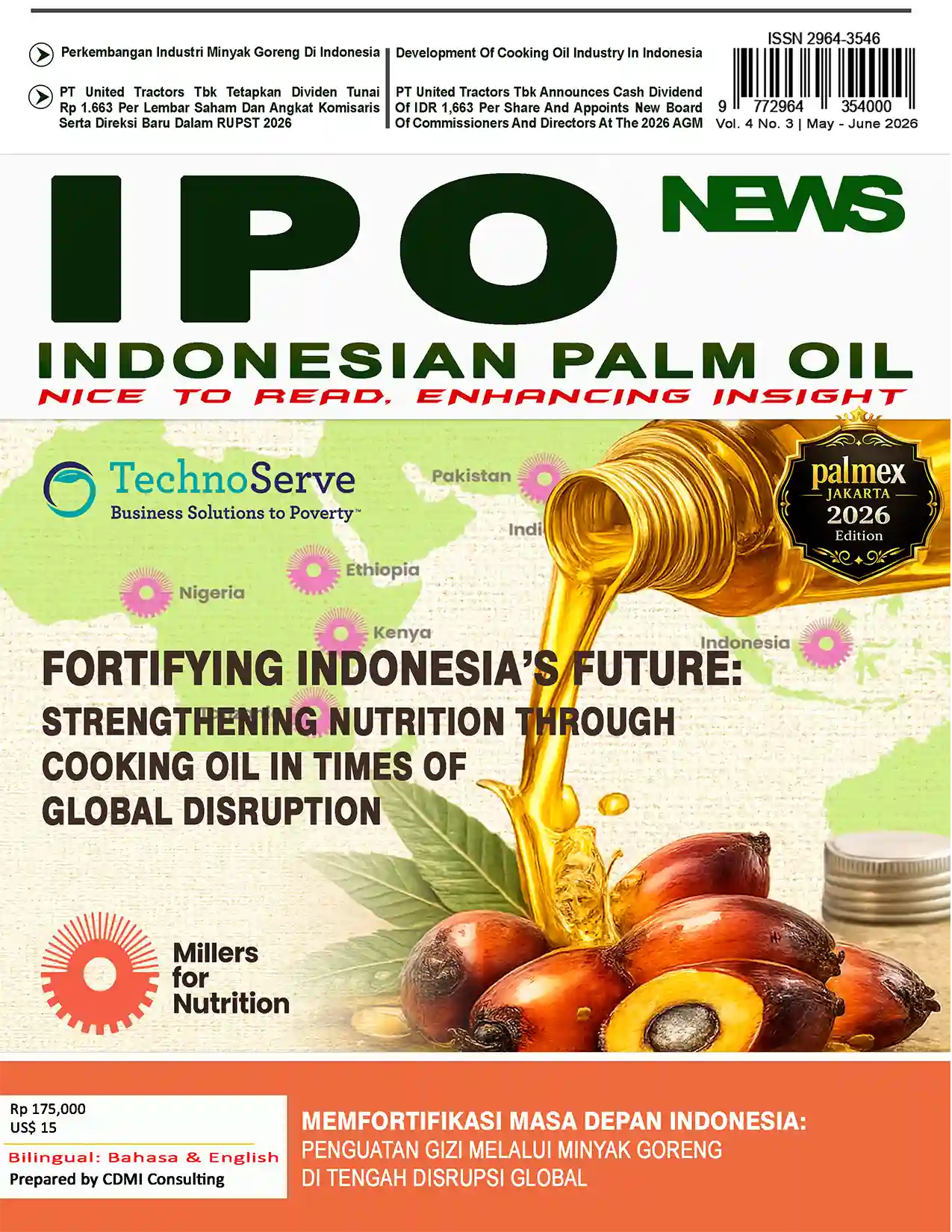
This perspective is at the heart of Millers for Nutrition, a global coalition supported and implemented by TechnoServe, which works with food millers and processors to strengthen food fortification practices and improve the nutritional quality of staple foods.
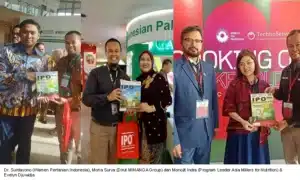
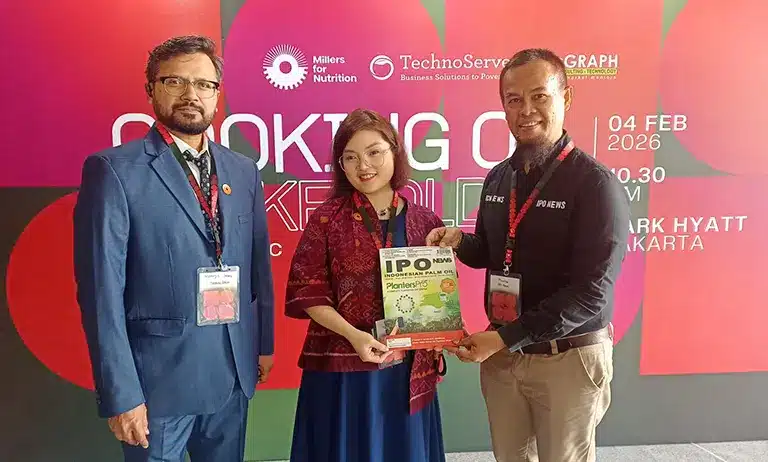
In Indonesia, Millers for Nutrition was officially launched in June 2025 through a collaboration between TechnoServe and the Indonesian Nutrition Foundation for Food Fortification (KFI). The initiative brings together government institutions, industry players and other stakeholders across the food sector.
For Indonesia’s palm oil and edible oil industries, the initiative is particularly relevant because edible oil is explicitly identified as one of the three major food vehicles targeted by Millers for Nutrition, alongside rice and flour.
From Food Production to Nutritional Quality
Discussions about Indonesia’s edible oil industry have traditionally focused on production capacity, raw material availability, refinery efficiency, pricing, distribution and consumption.
Food fortification introduces another important perspective.
The question is no longer only how much food can be produced, but also how widely consumed food products can contribute to meeting people’s nutritional needs.
TechnoServe describes fortification as the process of adding essential vitamins and minerals to food in order to help address micronutrient deficiencies.
Because fortified foods can be consumed through existing dietary patterns, fortification offers an opportunity to improve nutrient intake without requiring fundamental changes in consumer behavior.
For a country with a large population such as Indonesia, this approach has significant potential.
When a food product is consumed on a large scale, improvements in its nutritional quality can potentially generate benefits across a broad segment of the population.
Why Indonesia Matters
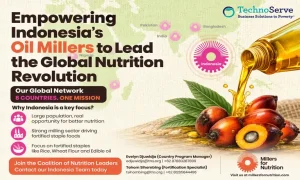
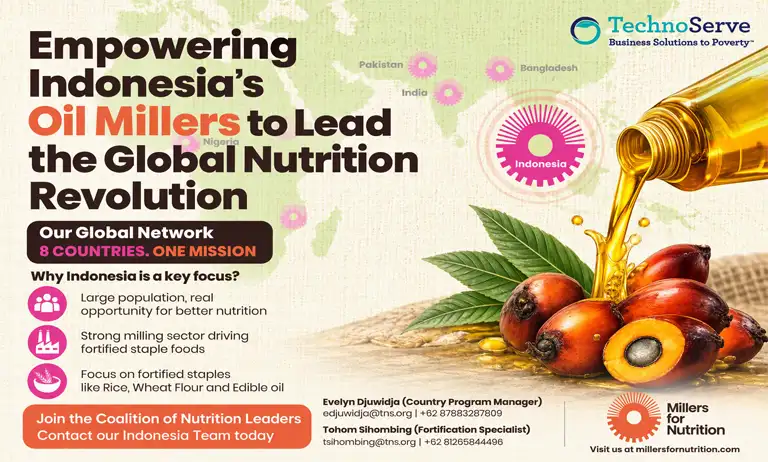
Indonesia is one of the key countries targeted by Millers for Nutrition because of its large population, strong food-processing sector and the opportunity to strengthen the nutritional quality of staple foods.
The program currently operates across eight countries: Bangladesh, Ethiopia, India, Indonesia, Kenya, Nigeria, Pakistan and Tanzania.
Its focus includes three major food vehicles: rice, edible oil, and flour based on wheat and maize.
In Indonesia, the initiative involves a broad range of stakeholders. The launch of the program brought together representatives from government institutions, including Bappenas, the National Food Agency and BULOG, as well as industry associations representing flour, edible oil and rice.
This demonstrates that food fortification is not simply an issue for individual food manufacturers.
It requires an ecosystem involving government, industry, technical institutions, academia, laboratories and development organizations.
Edible Oil: A Strategic Opportunity for the Palm Oil Industry
For Indonesia’s palm oil industry, the inclusion of edible oil as one of the key food vehicles is particularly significant.
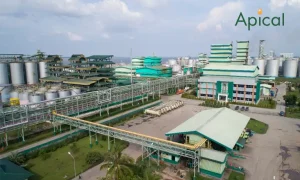
Indonesia has developed an extensive palm oil value chain, covering plantations, crude palm oil and palm kernel processing, refining and the production of various downstream products, including cooking oil and food ingredients.
This means that the palm oil industry is directly connected to one of the food categories being addressed by Millers for Nutrition.
It also creates a broader discussion about value addition in the palm oil sector.
Palm oil downstreaming is often associated with oleochemicals, biodiesel, specialty fats and other industrial products.
However, strengthening the nutritional quality of food products derived from edible oils could become another dimension of downstream development.
In other words, value creation does not necessarily stop when CPO is transformed into edible oil.
The next level of value creation can involve improving product quality and, where appropriate, contributing to nutritional objectives through food fortification.
Fortification Goes Beyond Adding Vitamins
One important aspect of Millers for Nutrition is that food fortification is not viewed simply as the process of adding micronutrients to a product.
TechnoServe’s approach also involves technical assistance, capacity building, product testing, digital tools, knowledge sharing and access to data and technical resources related to fortification.
The quality of the process is therefore just as important as the final product.
Fortification needs to be carried out accurately and consistently while complying with applicable standards and quality requirements.
This is where industrial capability becomes critical.
Food manufacturers need reliable production systems, quality-control procedures, testing capabilities and process monitoring to ensure that products consistently meet the required specifications.
For large-scale food industries, this means that fortification can become part of a broader strategy for improving manufacturing systems and quality management.
A Business Opportunity as Well as a Nutrition Agenda
Millers for Nutrition also brings a business perspective to the nutrition agenda.
TechnoServe emphasizes that support for food-processing companies is designed not only to improve nutritional quality, but also to strengthen operational competitiveness and create opportunities for market development.
This means fortification does not necessarily have to be viewed simply as an additional cost for industry.
With the right business model, improving product quality can become part of a company’s strategy to strengthen its reputation, meet market requirements, increase consumer confidence and develop new commercial opportunities.
TechnoServe’s approach also highlights the importance of business incentives, technical capacity, evidence and partnerships in making food fortification sustainable over the long term.
For food manufacturers, this creates an important connection between nutrition, technology, efficiency and business sustainability.
Early Experience in Indonesia
The Millers for Nutrition initiative in Indonesia builds on practical experience rather than being simply a new concept.
TechnoServe has previously worked with food-sector companies in Indonesia to improve technical processes related to fortification.
One example highlighted by TechnoServe is its collaboration with PT Thara Jaya Niaga, a producer of fortified rice kernels and a rice milling company.
Through technical assistance, the company reportedly improved its production processes, including achieving a 50% reduction in fortified rice kernel production costs, while also strengthening standard operating procedures and product consistency.
The experience illustrates how technical support can potentially generate both nutritional and commercial benefits.
Improved fortification practices can go hand in hand with better production efficiency, quality control and cost management.
This type of approach is now being expanded through Millers for Nutrition.
A New Area for Collaboration with Indonesia’s Palm Oil Industry
With edible oil included among the program’s key food vehicles, Indonesia’s edible oil industry has an opportunity to explore deeper engagement.
Potential collaboration can involve edible oil producers, industry associations, technology providers, premix manufacturers, testing laboratories, research institutions, government agencies and organizations working on nutrition and food security.
For the palm oil industry, such collaboration could also strengthen the broader narrative around downstream development.
Downstreaming is not only about increasing the economic value of a commodity.
It can also involve product quality, innovation, nutrition, consumer benefits and broader social value.
This becomes increasingly relevant as Indonesia seeks to strengthen its position not merely as a producer of palm oil, but as a major player across the global food and downstream value chain.
Toward a Higher-Value Food Industry
Millers for Nutrition currently operates across eight countries, connecting food-processing companies with technical experts, fortification specialists and broader ecosystem partners.
For Indonesia, the challenge is to translate this initiative into consistent and sustainable practices at the industrial level.
For the edible oil sector, the larger question is therefore not simply whether fortification can be implemented.
The more strategic question is:
How far can Indonesia’s edible oil industry integrate nutritional quality into its innovation and business strategy?
With the right collaboration between government, industry and technical organizations, the edible oil sector could play a broader role in Indonesia’s food system—not only by supplying products consumed by millions of people, but also by supporting the country’s wider nutrition objectives.
For Indonesia’s palm oil industry, this represents another opportunity to demonstrate that palm oil downstreaming can create not only greater economic value, but also broader social value.
FOR MORE INFORMATION
For further information about TechnoServe and the Millers for Nutrition program, please contact the TechnoServe Indonesia team:
Evelyn Djuwidja
Country Program Manager
✉️ edjuwidja@tns.org | 📱 +62 878-8328-7809
Tohom Sihombing
Fortification Specialist
✉️ tsihombing@tns.org | 📱 +62 812-6584-4496
Muslim M. Amin
Editor in Chief, IPO NEWS
To subscribe or for more information, contact: Marketing Or Email
Need a research report? Please visit CDMI Consulting