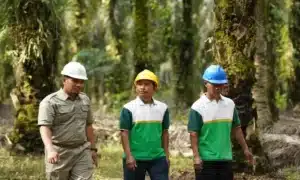
Indonesian Palm Oil News (IPO News), Ketapang – Resolving conflicts in the oil palm plantation sector requires more than just legal approaches. Understanding local social conditions, cultural values, and community wisdom is equally important in building harmonious relationships between plantation companies and communities surrounding their operational areas.
This perspective was shared by Priyanto P.S., Chief Corporate Affairs Officer of Bumitama, during the Aliansi Jurnalis Ketapang (AJK) Forum, which discussed various issues and challenges facing the oil palm plantation industry, particularly concerning relations between companies and local communities.
According to Priyanto, each region has its own distinct social and cultural characteristics. Therefore, companies need to understand local community conditions before taking steps to address various issues that may arise around their plantation areas.
He emphasized that communication and cooperation are essential in managing differences in interests and preventing them from escalating into prolonged conflicts.
For plantation companies, an appropriate social approach is not only necessary when disputes arise. It should also form an integral part of their community engagement strategy in day-to-day operations.
LAND DISPUTES AND INDIGENOUS COMMUNITY RIGHTS
Looking towards 2027, the oil palm plantation industry is expected to continue facing several challenges, particularly those related to land disputes, indigenous community rights, regulatory developments, and environmental law enforcement.
Land licensing issues and regional administrative changes are also important considerations, as they may affect relationships between companies, local governments, and communities.
In addition, the circulation of unverified information through social media may shape public perceptions and potentially trigger misunderstandings within communities.
Under these circumstances, companies are expected to adopt greater transparency in their communication and ensure that every issue is addressed by considering the circumstances and interests of all parties involved.
Indigenous land issues, for example, require an understanding of historical land ownership, community social structures, and the role of customary leaders in local community life.
Therefore, resolving plantation-related issues requires dialogue and collaboration, while ensuring that applicable laws and community rights are respected.
UNDERSTANDING COMMUNITY NEEDS
Priyanto also highlighted the importance of understanding community needs comprehensively. These needs are not limited to economic aspects but also include basic necessities, security, social recognition, and opportunities for personal development.
An approach that takes community needs into account can help companies establish more effective communication and foster mutually respectful relationships.
In practice, relationships between companies and communities cannot be built solely through social assistance programmes. They require continuous communication, community involvement, and collaboration with various local stakeholders.
Bumitama considers harmonious community relations an important part of sustainable plantation business practices. Open communication, respect for local wisdom, and cooperation with various stakeholders are among the approaches emphasized by the company.
SOCIAL RELATIONS AS A FACTOR IN BUSINESS SUSTAINABILITY
Social issues are among the factors that can influence the operational continuity of oil palm plantation companies.
Prolonged land conflicts may disrupt plantation activities, create business uncertainty, and affect relationships between companies, communities, and local governments.
Conversely, relationships built through open communication and constructive conflict resolution can help create a more conducive operating environment.
For large plantation groups such as Bumitama, managing community relations is increasingly important, considering that their operations involve multiple regions, communities, and stakeholders.
Going forward, the success of the palm oil industry will not be determined solely by plantation acreage, FFB productivity, mill capacity, or CPO production. A company’s ability to maintain good relations with communities and respect local rights will also be an important element in building a sustainable business.
In this context, the sociocultural approach highlighted by Bumitama represents an important perspective in addressing the challenges facing Indonesia’s oil palm plantation industry towards 2027.
Muslim M. Amin, Editor in Chief
IPO NEWS
Research-Based Palm Oil Media
To subscribe or for more information, contact: Marketing Or Email
Need a research report? Please visit CDMI Consulting