Indonesian Palm Oil News (IPO News) – After summoning eight executives representing 10 business entities, the Singapore government has strengthened its transboundary haze pollution law. Companies found in violation of the law may face fines of up to S$1 million per day, subject to a maximum of S$20 million.
The Singapore government is stepping up its efforts to address transboundary haze pollution caused by forest and land fires across Southeast Asia, including Indonesia.
Singapore’s latest measures go beyond summoning executives from major companies on October 28, 2026. The government has also strengthened its legal framework to investigate corporate links to fires that cause, or potentially cause, haze pollution in Singapore.
On November 4, 2026, Singapore’s Parliament considered amendments to the Transboundary Haze Pollution Act. The amendments were subsequently passed and came into force on November 19, 2026.
Under the revised law, the Singapore government has broader powers to investigate corporate activities, business relationships, and supply chains that may be linked to forest and land fires outside Singapore.
MAXIMUM FINE OF S$20 MILLION
One of the most significant changes is the increase in penalties for parties found guilty of the principal offences under the Act.
The maximum fine has been raised from S$2 million to S$20 million. In addition, fines may reach S$1 million for each day, or part of a day, during which haze pollution or the risk of haze pollution in Singapore arises from fires connected to the offence, subject to the overall S$20 million cap.
Courts may also consider any profits gained or losses avoided as a result of the offence when determining additional penalties.
The amendments also introduce a civil penalty mechanism of up to S$10 million, imposed through court proceedings with the consent of the Public Prosecutor.
These changes significantly increase the potential legal exposure of companies found responsible for fires that cause or contribute to transboundary haze pollution.
GOVERNMENT CAN TRACE CORPORATE RELATIONSHIPS AND SUPPLY CHAINS
The revised law also empowers the Singapore government to require companies suspected of having links to haze pollution to appoint independent private-sector assessors.
These assessors may include investigation firms, consultants, and law firms appointed through a government-established panel.
Their role is to examine operational activities, inter-company relationships, ownership structures, and supply chains to help the authorities establish whether companies may have connections to the fires.
The cost of the assessment is borne by the company being assessed. The resulting report is submitted to the National Environment Agency (NEA), which will determine whether further action is necessary.
It is important to note that being required to undergo an independent assessment does not automatically mean that a company has committed an offence. Legal responsibility must still be established by the relevant authorities and the courts.
EIGHT CORPORATE EXECUTIVES SUMMONED
Earlier, on October 28, 2026, eight executives representing 10 business entities met with three senior Singapore government officials: Deputy Prime Minister Gan Kim Yong, Senior Minister K. Shanmugam, and Minister for Sustainability and the Environment Grace Fu.
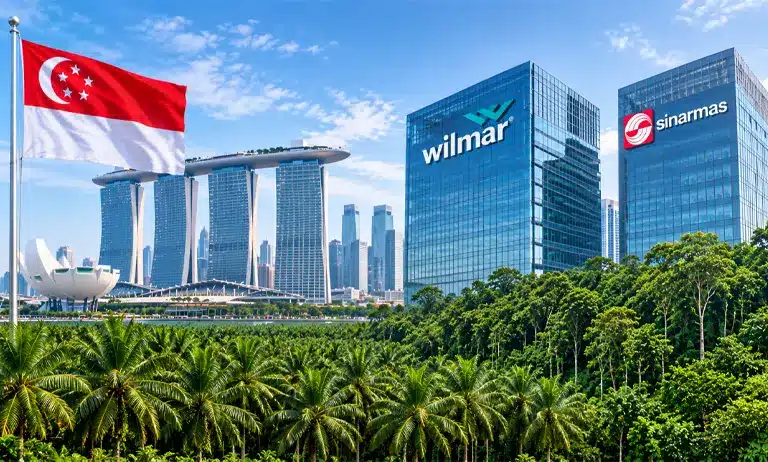
The eight executives represented Bumitama Agri, First Resources, Golden Agri-Resources, Indofood Agri Resources, Kencana Agri, TSH Resources, Wilmar International, and Sinar Mas Group.
The Sinar Mas representative also represented Asia Pulp & Paper (APP) and APP China at the meeting.
The Singapore government urged all companies to cooperate fully with the investigation process, including by providing access to relevant information, documents, operational activities, and corporate relationships.
SEVERAL COMPANIES EXPRESS WILLINGNESS TO COOPERATE
Developments following the meeting indicate that several companies have expressed their willingness to participate in independent assessment processes.
On October 31, 2026, the Singapore government announced the establishment of a special panel comprising seven investigation firms, law firms, and legal advisers.
The panel includes firms with expertise in forensic investigations, financial analysis, corporate intelligence, risk consulting, and legal services.
Several companies under the government’s scrutiny subsequently indicated their willingness to cooperate with the assessment process.
Through these assessments, the Singapore government aims to obtain more comprehensive information about corporate relationships between Singapore and Indonesia, including concession ownership, operational activities, and fire prevention and management measures.
NEW RISKS FOR INDONESIA’S PALM OIL INDUSTRY
These developments are particularly significant for Indonesia’s palm oil industry. The potential implications extend beyond companies operating directly in Indonesia and may also involve parent entities, affiliated companies, and business relationships across supply chains.
For plantation groups with cross-border operations, oversight of land management, fire prevention, and environmental compliance will become increasingly important.
Singapore’s revised law also allows the government to impose restrictions on business relationships involving certain entities designated under the Act. Such restrictions may cover transactions involving goods and services, as well as financial support.
For Indonesian palm oil companies, this serves as a reminder that environmental management and supply-chain transparency are increasingly linked to market access, investor confidence, and long-term international business sustainability.
However, as of November 24, 2026, the investigations involving companies under Singapore’s scrutiny should not be interpreted as proof that all of them have caused fires or haze pollution.
The investigation and independent assessment processes remain essential steps in establishing the facts and determining whether any legal responsibility exists.
ENVIRONMENTAL OVERSIGHT IS BECOMING A BUSINESS RISK
Singapore’s strengthened regulations demonstrate that forest and land fire issues now carry increasingly significant implications for businesses.
The authorities’ attention is no longer limited to concession owners. Corporate relationships, supply chains, and other parties with relevant business connections may also come under scrutiny.
For Indonesia’s palm oil industry, the ability to protect the environment, prevent fires, and demonstrate operational compliance will be increasingly important in maintaining corporate reputation and competitiveness in global markets.
IPO NEWS – Research-Based Palm Oil Media
Muslim M. Amin, Editor in Chief
To subscribe or for more information, contact: Marketing Or Email
Need a research report? Please visit CDMI Consulting