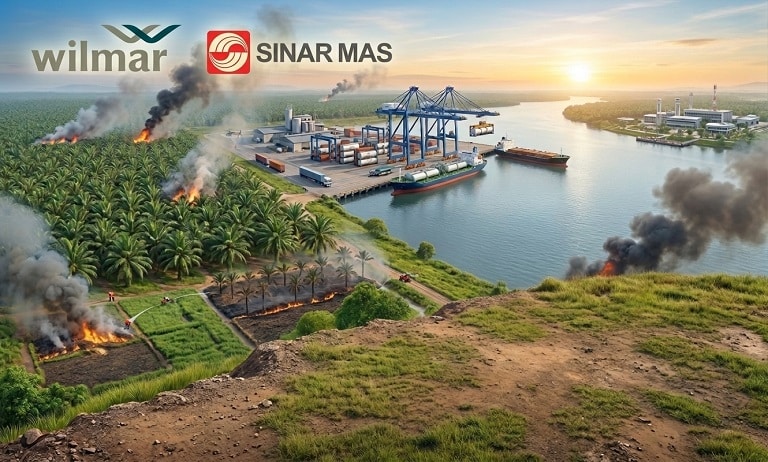
WALHI’s findings examine the links between dozens of companies and major business groups. Singaporean authorities have also sought information from companies in connection with transboundary haze, but alleged involvement must be established through investigation.
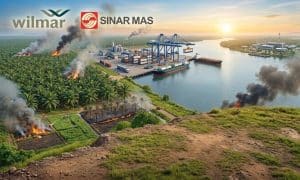
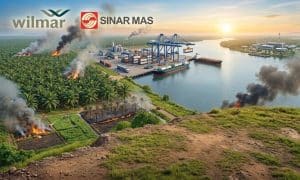
Indonesian Palm Oil News (IPO News), JAKARTA — Wilmar International and the Sinar Mas business group have come under scrutiny in discussions surrounding forest and land fires in Indonesia in 2026. The scrutiny comes amid growing attention to fire hotspots in concession areas, corporate ownership structures, and businesses’ responsibilities in preventing fires that may cause transboundary haze.
Two significant developments took place in October 2026. The Indonesian Forum for the Environment (WALHI) published a study examining companies associated with high concentrations of detected hotspots. Meanwhile, Singapore’s environmental authorities sought information from several companies with concessions or business links to areas in Indonesia associated with fires and haze.
These developments have intensified scrutiny of concession management and environmental oversight in the plantation and forestry sectors. However, detected hotspots, corporate ownership links and requests for information from authorities must be distinguished from proof that a company deliberately set fires.
WALHI TRACES LINKS TO 93 COMPANIES AFFILIATED WITH MAJOR BUSINESS GROUPS
On October 14, 2026, WALHI released a study titled Siapa di Balik Api? (Who Is Behind the Fires?), examining ownership relationships, corporate networks and business control involving concessions with high indications of fire hotspots.
The study examined 93 companies identified as potentially associated with forest and land fires and affiliated with business groups originating from Singapore and Malaysia, including Wilmar, Sinar Mas, Musim Mas and First Resources.
WALHI combined spatial analysis based on satellite data with investigations into corporate ownership structures, management, shareholders and ultimate beneficial owners. The organization argued that investigations should not stop at the companies holding concession permits, but should also consider links to business groups that control or benefit economically from the activities concerned.
One of the study’s findings concerned the food and energy development area in Merauke, South Papua. WALHI recorded 807 hotspots between January 1 and August 31, 2026. Of these, 133 were identified across six Energy Estate project entities affiliated with First Resources and Wilmar International, while the remaining 674 were located across four Food Estate clusters under government institutional oversight.
These findings indicate the need for further examination of land management and project implementation in areas with concentrations of hotspots. However, the presence of hotspots in a particular area does not, by itself, establish who started the fires or whether they were caused by the activities of a specific company.
SINGAPOREAN AUTHORITIES SEEK INFORMATION FROM WILMAR AND GOLDEN AGRI
On October 23, 2026, The Business Times reported that Singapore’s National Environment Agency (NEA) had issued notices to 10 Singapore-registered companies, including Wilmar International and Golden Agri International.
The notices were issued under Section 10 of Singapore’s Transboundary Haze Pollution Act. NEA requested information about the companies’ relationships with related entities in Singapore and Indonesia, concession locations, and measures taken to prevent and address fires during the dry season.
Golden Agri International is a Singapore-based entity affiliated with Golden Agri-Resources (GAR), a palm oil agribusiness group associated with Sinar Mas. Accordingly, references to Golden Agri International must be understood in the context of the group’s corporate structure. They do not establish that PT SMART or Sinar Mas’s entire palm oil business was responsible for setting fires.
The notices form part of an information-gathering process intended to assess possible links between companies and transboundary haze. They are not court judgments and do not, in themselves, establish that any violation has occurred.
Singaporean authorities have indicated that they will examine corporate relationships between entities in Singapore and Indonesia and assess the evidence obtained through the process.
WILMAR REAFFIRMS ITS NO-BURNING POLICY
In response to reports concerning forest and land fires in Indonesia, Wilmar International issued an official statement on October 16, 2026.
The company said it had maintained a No Burning Policy since 2006. The policy applies to its operations, subsidiaries and third-party suppliers.
Wilmar also explained that its fire prevention system includes satellite hotspot monitoring, field inspections, routine patrols, and the deployment of firefighting equipment and teams.
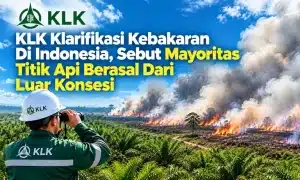
Addressing fires detected in parts of its concession areas, the company stated that, based on its own field assessments, the fires originated outside concession boundaries or on land cultivated by local communities within concession areas before spreading into areas managed by the company.
This statement represents the company’s position. Establishing the cause of each fire and determining responsibility require independent verification, including examination of fire locations, hotspot histories, land conditions and the findings of relevant authorities.
PALM OIL AND FORESTRY OPERATIONS WITHIN SINAR MAS MUST BE DISTINGUISHED
Two business sectors need to be distinguished when assessing forest and land fire issues involving Sinar Mas.
First, Golden Agri-Resources (GAR), which operates in palm oil-based agribusiness and is associated with PT Sinar Mas Agro Resources and Technology (SMART).
Second, Asia Pulp & Paper (APP), a business group operating in the pulp and paper industry. APP has also drawn attention following the detection of fires in concessions operated by some of its suppliers.
In a report published on October 19, 2026, The Business Times reported that APP said almost all fires detected across three supplier concessions between July and October had originated outside the concession boundaries before spreading into those areas. APP said it was working with the relevant suppliers to address the fires and strengthen prevention measures.
APP’s explanation should not automatically be treated as evidence of conditions across all GAR or SMART palm oil plantations. Similarly, APP’s association with Sinar Mas does not, by itself, establish that the parent group or all its subsidiaries were responsible for specific fires.
Each incident must be assessed according to its location, permit holder, land manager, cause and available evidence.
ACCOUNTABILITY MUST BE ESTABLISHED THROUGH EVIDENCE
Forest and land fires have far-reaching environmental, social and economic consequences. They can damage ecosystems, threaten public health, disrupt economic activities and generate haze that crosses national borders.
Companies managing plantation and forestry concessions therefore need effective fire prevention systems, emergency response capabilities and monitoring mechanisms covering activities within and around their operational areas.
At the same time, responsibility must be determined on the basis of verifiable evidence. Satellite data can help identify the location and timing of hotspots, but it must be supplemented by field inspections and investigations to establish the causes of fires and identify the responsible parties.
WALHI’s study of corporate affiliations, Wilmar’s official statement and Singaporean authorities’ requests for information provide important material for further examination. However, these sources serve different purposes: an environmental organization’s study identifies patterns and risks, a company’s statement explains its position, and an official inquiry seeks to gather information and establish the facts.
CONCLUSION
Wilmar International and the Sinar Mas business group have come under scrutiny over forest and land fire issues in 2026. WALHI has examined the links between companies identified as potentially associated with fires and major business groups, while Singaporean authorities have sought information from Wilmar International and Golden Agri International in connection with transboundary haze concerns.
Nevertheless, these developments do not establish that Wilmar or Sinar Mas’s palm oil businesses deliberately burned forests or land.
Determining responsibility requires a comprehensive, transparent and evidence-based investigation. For Indonesia’s palm oil and forestry industries, these developments underscore the importance of fire prevention, information transparency and oversight throughout the business supply chain in protecting sustainability and maintaining international market confidence.
Sources: WALHI, October 14, 2026; Wilmar International official statement, October 16, 2026; The Business Times, October 19 and 23, 2026.
To subscribe or for more information, contact: Marketing Or Email
Need a research report? Please visit CDMI Consulting