4.1 Million Hectares, Papua Selatan and a Bold Vision for Indonesia’s Palm Oil Ecosystem
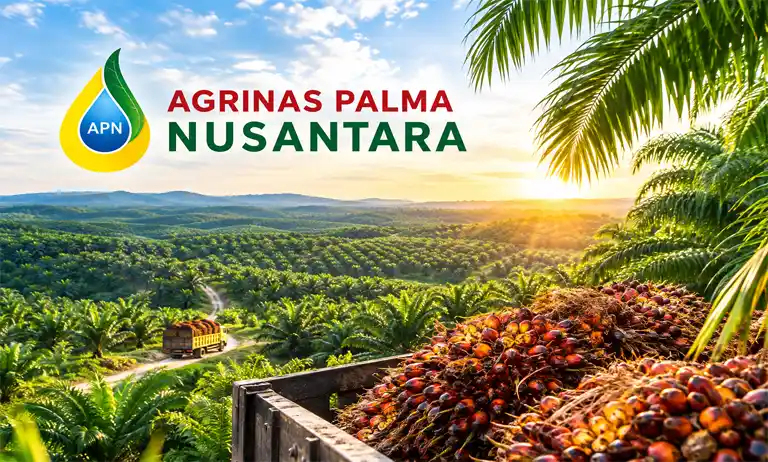
Indonesian Palm Oil News (IPO News), Jakarta — PT Agrinas Palma Nusantara (Persero) is entering a new phase in its transformation. The state-owned plantation company is not only entrusted with managing state plantation assets, but is also pursuing a broader agenda covering productivity improvement, smallholder partnerships, new plantation development, downstream processing and bioenergy.
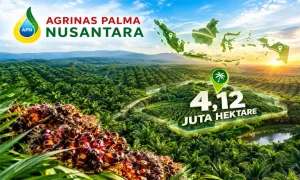
The scale of its mandate is substantial. Agrinas Palma has been entrusted with approximately 4.1 million hectares of land, largely originating from areas reclaimed by the state through the government’s forest-area enforcement programme.
However, the 4.1 million hectares should not be interpreted as 4.1 million hectares of productive oil palm plantations.
By the end of 2025, approximately 1.7 million hectares had been entrusted to Agrinas, with around 730,000 hectares already planted with active oil palm. A further 2.37 million hectares was handed over in May 2026 under the seventh stage, bringing the total area entrusted to Agrinas to approximately 4.12 million hectares.
Papua Selatan Becomes A Major Focus
One of Agrinas Palma’s most significant initiatives is the planned development of approximately 400,000 hectares in Papua Selatan.
The area covers parts of Boven Digoel, Mappi, Merauke and Asmat. Based on management’s explanation, around 250,000 hectares are planned for oil palm, while other areas are intended for conservation and cultural purposes.
The plan is not simply about establishing new plantations. Agrinas is also emphasizing land suitability, environmental considerations and community involvement.
The latest development came on 15 September 2026, when Agrinas Palma and Cenderawasih University (Uncen) agreed to conduct joint research and studies to support the planned development of the plantation and food-production area.
The study will cover land suitability, productivity improvement, sustainable cultivation, downstream agro-industry, farmer empowerment, governance, environmental and social considerations.
Smallholders And Communities
Smallholder partnerships are becoming an important part of Agrinas Palma’s strategy.
The company has set a target of developing at least 250,000 hectares of plasma plantations as part of its long-term partnership programme.
Agrinas has also identified more than 130,000 hectares of smallholder oil palm plantations within forest areas that are being considered for partnership arrangements with local communities. Under the proposed model, communities can remain involved in plantation maintenance, harvesting and fresh fruit bunch transportation while benefiting economically from the partnership.
The approach is significant because the success of large-scale plantation development will depend not only on land and capital, but also on long-term relationships with surrounding communities.
From Palm Oil To Bioenergy
Agrinas Palma’s transformation is also increasingly connected to Indonesia’s national energy agenda.
On 10 September 2026, Agrinas Palma met with Pertamina and Pertamina Power Indonesia to discuss expanding integrated bioenergy cooperation, covering feedstock supply, processing facilities, energy infrastructure, logistics, distribution and product offtake.
This direction reflects the growing strategic role of palm oil as a renewable-energy feedstock.
Agrinas has previously outlined its plans to support national food and energy security, including the development of palm oil, biodiesel and other downstream products.
Productivity Remains The Key
For Agrinas Palma, however, the future of the palm oil sector is not simply about expanding acreage.
Productivity will be critical.
Replanting ageing plantations, improving planting materials, adopting better agricultural practices, strengthening farmer capabilities and improving plantation management will all determine how effectively Indonesia can increase palm oil output without relying solely on new land development.
This also makes the Smallholder Palm Oil Replanting Programme (PSR) increasingly important.
Agrinas sees substantial room to improve smallholder productivity through better cultivation practices, replanting and stronger farmer institutions.
Not Only Palm Oil
Agrinas Palma’s mandate also extends into food commodities and bioenergy.
The company has been assigned to develop approximately 400,000 hectares of soybean, 300,000 hectares of cassava and 250,000 hectares of corn.
Cassava is also being positioned as a feedstock for bioethanol.
In the energy sector, Agrinas plans to reactivate a biodiesel facility in Rengat, Riau, with a capacity of approximately 600,000 tonnes, targeted to resume operations by the end of 2027.
The company has also outlined plans for a cassava-to-bioethanol processing facility with a capacity of approximately 185,000 tonnes.
The emerging business model can therefore be described as:
Plantation → Feedstock → Processing → Energy → Downstream Value Creation.
Turning Land Into Economic Value
With more than four million hectares under its management mandate, Agrinas Palma’s biggest challenge is not simply the size of the land bank.
The more important questions are: How much of the land is productive? What is its productivity? How quickly can the assets be developed? And how much economic value can ultimately be generated for farmers, communities and the state?
Land verification, legal processes, infrastructure, replanting, intensification and human-resource development will therefore remain critical priorities.
The scale of the mandate will only become economically meaningful when the land is transformed into productive plantations, stronger farmer incomes, employment, downstream industries and greater contributions to national food and energy security.
A New Chapter For Agrinas Palma
Agrinas Palma Nusantara is now approaching an important turning point.
From an entity primarily associated with the management of state plantation assets, the company is moving toward an integrated agro-industrial model connecting palm oil, food, smallholders, downstream processing and energy.
With approximately 4.1 million hectares entrusted for management, a planned 400,000-hectare development in Papua Selatan, a target of 250,000 hectares of plasma plantations, productivity-improvement programmes and a growing bioenergy agenda, the scale of its transformation is significant.
Ultimately, however, success will not be measured solely by the size of the land area.
It will be measured by whether these assets become productive, whether farmers and communities receive meaningful economic benefits, whether downstream industries grow, and whether the programme contributes to Indonesia’s long-term food and energy security.
This is Agrinas Palma Nusantara’s new chapter: moving from asset management toward the development of an integrated national agribusiness ecosystem.
For Indonesia’s palm oil industry, the company’s transformation will be a development worth watching closely.
To subscribe or for more information, contact: Marketing Or Email
Need a research report? Please visit CDMI Consulting