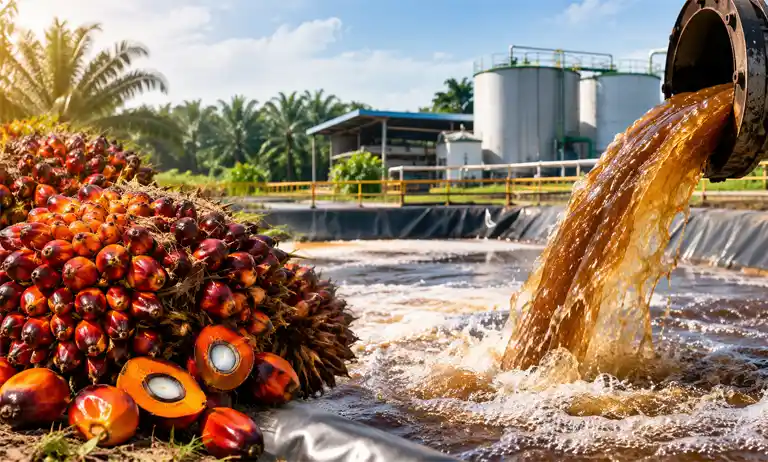
Indonesian Palm Oil News (IPO News), Jakarta – Indonesia is not only recognized as one of the world’s largest palm oil producers. Behind this enormous palm oil production, the country’s palm oil industry also generates a substantial volume of palm oil mill effluent (POME) every year.
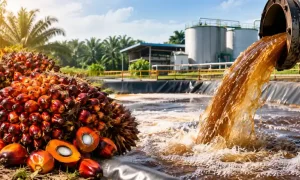
Wageningen University & Research (WUR) estimates that Indonesia’s palm oil industry generates nearly 100 million tonnes of POME annually. This figure highlights the enormous scale of POME resources available in Indonesia and their potential to be further developed as a valuable industrial resource.
For many years, POME has primarily been regarded as a liquid waste stream that needs to be properly managed. However, advances in technology are creating opportunities to transform POME from a by-product of palm oil processing into a source of energy and other value-added products.
More Than Just Waste
POME is the liquid effluent generated during the processing of fresh fruit bunches (FFB) into crude palm oil (CPO).
The volume of POME generated is closely linked to the scale of Indonesia’s palm oil industry. The greater the volume of FFB processed by palm oil mills, the greater the amount of POME generated.
A number of studies use a ratio of approximately 2.5–3.37 cubic metres of POME per tonne of CPO produced, although the actual ratio can vary depending on mill characteristics and processing methods.
This means POME is not a small or isolated resource. Virtually every major palm oil-producing region in Indonesia has POME resources that could potentially be further developed.
Nearly 100 Million Tonnes Every Year
The nearly 100-million-tonne annual figure provides a clear picture of the enormous resource generated by Indonesia’s palm oil industry.
This volume comes from palm oil processing activities carried out every day at mills across the country. As a result, POME represents a resource that is widely distributed, continuously generated and available as long as palm oil mills remain in operation.
With POME resources on such a massive scale, an increasing number of companies and technology developers are seeking to develop advanced technologies to process POME into higher-value products.
Such technological developments could enable Indonesia not only to address waste-management challenges, but also to create new economic opportunities, increase the added value of the palm oil industry and potentially generate additional foreign-exchange earnings through higher-value products that can reach international markets.
From Waste to Energy
One of the most established applications for POME is biogas production.
POME contains a high level of organic matter and can be processed through anaerobic digestion technology to produce biogas. The biogas can then be utilized as an energy source, including for electricity generation and energy requirements within palm oil mill operations.
This creates a dual benefit. On one hand, companies can improve their waste-management practices. On the other, the resulting energy can help meet operational energy requirements and reduce reliance on conventional energy sources.
Given Indonesia’s enormous POME resources, there remains considerable room to expand the development of POME-based biogas projects.
Potential as a Biodiesel Feedstock
Beyond biogas, advances in technology are also creating opportunities to utilize the oil components contained in POME as feedstock for value-added products, including biodiesel.
This opportunity is becoming increasingly relevant as Indonesia continues to expand biodiesel utilization as part of its national energy policy.
Indonesia has implemented the B40 biodiesel mandate and is moving toward B50 implementation in 2026. Rising biodiesel demand underscores the importance of technology development, feedstock efficiency and the utilization of various domestic resources.
Against this backdrop, POME could become an interesting alternative feedstock to explore further, particularly if processing technologies can deliver efficient and economically viable conversion.
A New Economic Opportunity for the Palm Oil Industry
The potential of POME is relevant not only to technology providers, but also to plantation companies and palm oil mills.
If POME can be economically converted into energy or value-added products, palm oil companies could potentially generate additional value from a by-product of their existing production processes.
For palm oil mills, POME utilization could also form part of broader strategies to improve energy efficiency, reduce waste and develop a circular economy approach.
With POME generation estimated at nearly 100 million tonnes annually, significant opportunities remain for technology companies, investors and industry players capable of developing technically and economically viable processing solutions.
Technology and Economic Viability Remain Key Challenges
The enormous volume of POME does not mean that all of it automatically carries the same commercial value.
POME characteristics can vary from one mill to another. Processing technology, capital requirements, operating costs, infrastructure and the quality of the resulting products are all important factors in determining the feasibility of a project.
The challenge, therefore, is not simply how to process POME, but how to convert it into products with sufficient economic value to support the required investment and operating costs.
The palm oil industry needs solutions that can not only process POME, but also deliver consistent, efficient and commercially viable results.
Indonesia Has an Enormous Resource Base
With palm oil production spread across numerous regions of Indonesia, POME resources are also distributed across the country’s palm oil mills.
This creates opportunities for a variety of utilization models, ranging from biogas and energy production to technologies capable of producing other value-added products.
Going forward, POME could evolve from being primarily a waste-management issue into an important component of a new economic ecosystem within Indonesia’s palm oil industry.
Nearly 100 million tonnes of POME every year is more than just a big number. Behind this enormous volume lies an opportunity spanning technology, investment, energy and downstream industries.
For Indonesia, the challenge is no longer simply how to manage POME, but how to transform this resource into new economic value, strengthen the competitiveness of the palm oil industry and create opportunities for additional foreign-exchange earnings for Indonesia.
To subscribe or for more information, contact: Marketing Or Email
Need a research report? Please visit CDMI Consulting