
Indonesian Palm Oil News (IPO News) — Indonesia’s food security challenge is no longer just about producing enough food. It is about protecting the natural resources that sustain production, strengthening farmers’ livelihoods and ensuring that the food reaching households delivers adequate nutrition. As climate change, volatile commodity markets and competing demands on agricultural resources reshape the global food economy, building a resilient food system has become an economic and public health imperative.
As one of the world’s largest agricultural producers, Indonesia’s opportunity lies in connecting two priorities that are often addressed separately, namely regenerating the land that produces food and improving the nutritional value of the food. The palm oil sector offers a compelling starting point for this integrated approach, linking sustainability at the farm level with nutrition at the household level.
Resilience Begins with the Soil
Indonesia’s palm oil industry is central to its economy, rural livelihoods and domestic food supply. According to the country’s Ministry of Agriculture, the provi-sional figures for 2025 CPO production points at 46.5 million tonnes. The sector spans approximately 16.83 million hectares, with smallholders managing around 41% of the plantation area.

However, sustaining production at this scale requires more than increasing yields. Soil degradation, climate variability, water stress and rising agricultural input costs can undermine long-term productivity and leave farmers more vulnerable to economic and environ-mental shocks. Conventional cultivation practices and sustainability certification remain important, but resilience also requires restoring the ecological functions on which agricultural production depends.
Regenerative agriculture offers a practical pathway. Returning pruned palm fronds to the soil, applying compost and other organic amendments, maintaining ground cover and protecting riparian zones can improve soil structure, support nutrient cycling and reduce erosion. Biochar may also contribute to soil improvement where appropriate, while careful water management can help protect sensitive peatland ecosystems. Planting beneficial vegetation, including Turnera subulata, supports natural pest management, while barn owls can help control rodent populations and reduce dependence on chemical interventions.
The objective is to move beyond minimizing environmental damage towards improving the long-term health of agricultural landscapes. For smallholders, the economic case is equally important, which means more efficient use of resources, lower input costs, healthier soils and diversified income streams can make regenerative practices commercially attractive.
Smallholders at the Centre of Change
The transition to regenerative agriculture will succeed only if it works for the farmers who manage a substantial share of Indonesia’s oil palm plantations. Many face constraints involving finance, technical knowledge, market access and the costs of changing established practices.
Two initiatives in Kalimantan illustrate how locally adapted approaches can address these challenges. In Central Kalimantan, environmental organization Kaleka has worked with independent smallholders in Seruyan Regency to promote regenerative practices and more diverse farming systems, demonstrating that environmental protection and economic growth can go hand-in-hand.
In West Kalimantan, Solidaridad Indonesia, the Keling Kumang Oil Palm Farmers’ Association and the Credit Union Keling Kumang equipped smallholder farmers with training in regenerative agricultural and business practices, through establishment of local cooperatives, seed nurseries, and harvest collectivization. The initiative has successfully bypassed middlemen to boost farmer yields and incomes by up to 20%, while expanding RSPO/ISPO sustainable certification across the region.
These experiences demonstrate that regeneration is not a single technique but a transition towards farming systems that make better use of land, nutrients and biological diversity. Scaling such approaches requires farmer organizations, mills, government agencies and buyers to work together through technical assistance, quality planting material, finance and reliable market linkages
From Palm Oil to Better Nutrition
Resilience must extend beyond how food is produced to what it delivers to consumers. Adequate calorie availability is essential, but food security remains incomplete when ordinary diets do not provide the micronutrients needed for healthy lives. This is where Indonesia’s palm cooking oil industry connects agricultural production with public health.
Vitamin A fortification provides an established example. Given the widespread consumption of palm cooking oil across socio-economic groups, fortification offers a practical way to deliver this essential micronutrient through an everyday food product.
The challenge lies in ensuring consistent implementation. A significant volume of cooking oil has traditionally moved through unbranded bulk channels, known locally as minyak curah. The expansion of packaged cooking oil, including the Minyakita programme, alongside effective monitoring and industry collaboration, can help strengthen access to fortified oil.
Partnerships with refineries are
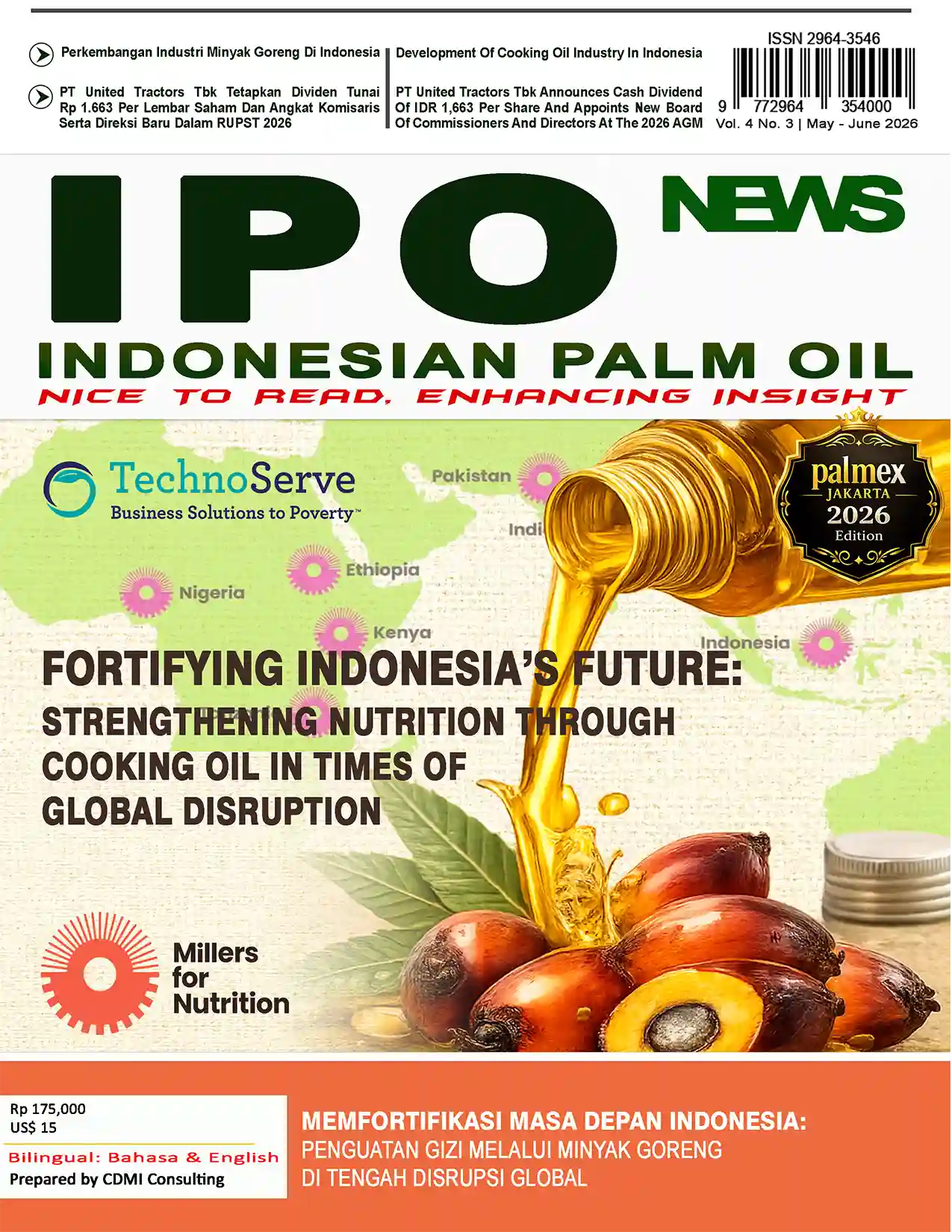
critical to this effort. Industry initiatives such as Millers for Nutrition, powered by TechnoServe, can contribute technical knowledge, support improvements in food processing practices by integrating fortification in the business value chain and recognizing the Champion Millers through prestigious National/Global Forums. Fortification must be accompanied by appropriate quality assurance, regulatory oversight and consumer awareness to make it sustainable.
Building a Connected Food System
Regenerative agriculture and food fortification are often treated as separate agendas: one focused on environmental sustainability, the other on nutrition policy. Yet both address the same fundamental question: how can Indonesia create a food system that delivers lasting value without undermining the resources on which future production depends?

The connection requires deliberate coordination. Healthier soils do not automatically guarantee fortified food, just as fortification cannot compensate for degraded land or vulnerable farming livelihoods. Government agencies must provide effective standards and incentives, businesses must invest in responsible production and quality assurance, and farmer organizations must help smallholders adopt practical, economically viable solutions.
For Indonesia, the opportunity is to create greater value from existing agricultural land while strengthening rural livelihoods and improving nutritional outcomes.
Ultimately, food system resilience must be measured by more than production volumes. It depends on how sustainably the land produces, how effectively farmers participate in value chains, and how well the resulting food meets people’s nutritional needs. Connecting regenerative palm oil with robust staple food fortification offers Indonesia a practical way to link the soil to the spoon.
Contributed by:
Mr. Monojit Indra (Senior Practice Lead – Food Processing & Market Systems, TechnoServe India, and Program Lead – Millers for Nutrition Asia) & Ms. Evelyn Djuwidja (Country Program Manager, Millers for nutrition, Indonesia)
Millers for Nutrition is supported by Strategic Fortification Partners: BASF, BioAnalyt, dsm-firmenich, Mühlenchemie, SternVitamin; Regional Strategic Fortification Partners: Hexagon Nutrition, Piramal Nutrition, Sanku; and a growing group of local technical partners that share a common vision of improving food processing practices and fortification excellence to benefit society and enhance business sustainability. Millers for Nutrition is powered by TechnoServe with funding support from the Gates Foundation. Millers, food fortification stakeholders, and others interested in joining the coalition can learn more at millersfornutrition.com
To subscribe or for more information, contact: Marketing Or Email
Need a research report? Please visit CDMI Consulting