Revenue grows 15.9%, while EBITDA reaches US$3.20 billion. China, Southeast Asia, India, Africa, and Europe remain important regions in Wilmar’s global business network.
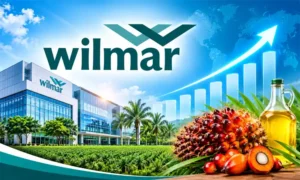
Indonesian Palm Oil News (IPO News) — Wilmar International Limited recorded strong revenue growth during the first nine months of 2026. The Singapore-headquartered global agribusiness group reported revenue of US$60.22 billion for the period ended September 30, 2026, representing a 15.9% increase from US$51.96 billion in the corresponding period last year.
Net profit also recorded a significant increase. Wilmar posted net profit of US$889.89 million, surging 259.9% compared with US$247.27 million in the first nine months of 2025.
Meanwhile, EBITDA rose 31.7% to US$3.20 billion from US$2.43 billion a year earlier.
However, one important indicator warrants attention. Wilmar’s core net profit declined by 3.4% to US$908.78 million, compared with US$940.94 million in the same period last year.
This difference indicates that the substantial increase in reported net profit does not entirely reflect an improvement in underlying operating performance. In the third quarter of 2025, Wilmar recorded a US$712.3 million compensation expense payable to the Indonesian government. Excluding this one-off expense provides a different perspective when comparing the two periods.
Accordingly, revenue and EBITDA growth remain positive indicators, although margin pressures in certain business segments still require attention.
Wilmar International’s Financial Performance
January–September 2026 compared with January–September 2025.
Indicator | 9M 2026 | 9M 2025 | Change
Revenue | US$60.22 billion | US$51.96 billion | +15.9%
Net profit | US$889.89 million | US$247.27 million | +259.9%
Core net profit | US$908.78 million | US$940.94 million | -3.4%
EBITDA | US$3.20 billion | US$2.43 billion | +31.7%
Source: Wilmar International, Executive Financial Summary, October 28, 2026.
Food Products Business Grows 16.5%
According to its operational report, the Food Products business was one of the key contributors to Wilmar’s sales volume growth during the first nine months of 2026.
Total sales volume in this segment reached 29.74 million tonnes, increasing 16.5% from 25.52 million tonnes in the corresponding period last year.
Growth was primarily supported by Consumer Products, which recorded sales volume of 9.17 million tonnes, up 38.7%. Meanwhile, Medium Pack and Bulk sales reached 20.56 million tonnes, representing an increase of 8.8%.
On the other hand, Feed and Industrial Products recorded sales volume of 51.09 million tonnes, up 1.2% from 50.50 million tonnes in the first nine months of 2025.
Within this business group, Oilseeds and Grains sales increased 4.6% to 23.62 million tonnes. However, Tropical Oils declined slightly by 0.5% to 19.51 million tonnes, while Sugar decreased 4.2% to 7.96 million tonnes.
Combined, the total sales volume of these two business segments reached approximately 80.83 million tonnes.
China And Southeast Asia Remain Key Markets
As a multinational agribusiness group, Wilmar operates an extensive production and distribution network across more than 50 countries and regions, supported by over 1,000 manufacturing facilities worldwide.
Its business activities span oil palm plantations, vegetable oil processing, commodity merchandising, oilseed crushing, edible oils, oleochemicals, specialty fats, biodiesel, and consumer food products.
Based on its 2025 Annual Report, China was Wilmar’s largest revenue-generating geographical market, contributing US$33.33 billion. Southeast Asia ranked second with revenue of US$16.15 billion.
Other regions included Africa with US$5.25 billion, India with US$2.74 billion, Europe with US$2.81 billion, Australia and New Zealand with US$2.64 billion, and other markets contributing US$7.50 billion.
Wilmar’s Revenue By Customer Location
Region | 2025 Revenue
China | US$33.33 billion
Southeast Asia | US$16.15 billion
Africa | US$5.25 billion
Europe | US$2.81 billion
India | US$2.74 billion
Australia & New Zealand | US$2.64 billion
Others | US$7.50 billion
Total | US$70.42 billion
Source: Wilmar International Annual Report 2025, geographical information based on customer location.
These figures illustrate the extensive reach of Wilmar’s global markets. They represent revenue based on customer location, rather than a breakdown of palm oil export volumes from Indonesia to individual countries.
China plays a particularly important role in Wilmar’s business, not only as a market for food products and vegetable oils, but also as a major centre for oilseed processing and industrial investment.
However, in the third quarter of 2026, Wilmar reported that its soybean crushing operations in China experienced pressure due to weaker processing margins.
Downstream Industry And Biodiesel Network
Wilmar’s strength extends beyond trading crude palm oil (CPO). The company also operates an integrated processing business covering vegetable oil processing, edible oils, specialty fats, oleochemicals, and biodiesel.
Indonesia and Malaysia serve as important bases for Wilmar’s palm oil plantation and processing activities. Meanwhile, its international manufacturing and distribution network enables the company to reach consumers and industrial customers across various markets.
In Indonesia, Wilmar operates more than 140 manufacturing facilities across more than 10 locations. Its business activities include oil palm plantations, vegetable oil refineries, palm kernel processing, oleochemicals, biodiesel, and branded edible oil products.
This extensive industrial network provides Wilmar with strategic advantages in developing higher value-added products and expanding its international market presence.
Challenges In Sustaining Growth
Despite the increase in revenue and EBITDA, Wilmar continues to face several operational challenges.
In its third-quarter 2026 report, management noted that higher raw material costs had put pressure on the Food Products business. Meanwhile, weaker soybean processing margins affected the performance of Feed and Industrial Products.
These conditions demonstrate that strong revenue growth does not necessarily translate into higher underlying profits.
Going forward, Wilmar’s ability to maintain processing efficiency, control raw material costs, strengthen its distribution network, and increase the contribution of higher value-added products will be crucial to sustaining its business performance.
With revenue reaching US$60.22 billion in the first nine months of 2026, Wilmar continues to demonstrate its significant scale in the global agribusiness industry.
For Indonesia’s palm oil industry, Wilmar’s performance remains particularly important given the company’s strong links with the domestic palm oil supply chain, spanning plantations, processing, trading, and downstream industries.
According to Indonesian Palm Oil News (IPO NEWS), the strength of global agribusiness companies such as Wilmar is determined not only by plantation areas and processing capacity, but also by their ability to develop international market networks and higher value-added downstream products.
To subscribe or for more information, contact: Marketing Or Email
Need a research report? Please visit CDMI Consulting