Indonesian Palm Oil News (IPO News) — The name Hardaya Plantation is closely associated with the business legacy of the late Murdaya Poo, one of Indonesia’s prominent entrepreneurs and the founder of the Central Cipta Murdaya (CCM) business group. Over the years, the group has developed interests across a number of industries, including plantations, with palm oil becoming one of its important business sectors.
Through its plantation subsidiaries, Hardaya Plantation has established a significant operational footprint, particularly in Central Sulawesi and North Kalimantan. Its long presence in these regions reflects the group’s commitment to developing plantation businesses outside Indonesia’s traditional palm oil centers.
PT Hardaya Inti Plantations: The Core of the Plantation Business
One of the key companies within the group is PT Hardaya Inti Plantations (HIP), which was established in 1995. HIP is part of the Central Cipta Murdaya Group and has been involved primarily in agriculture and plantation activities, including the development of oil palm plantations and crude palm oil (CPO) production.
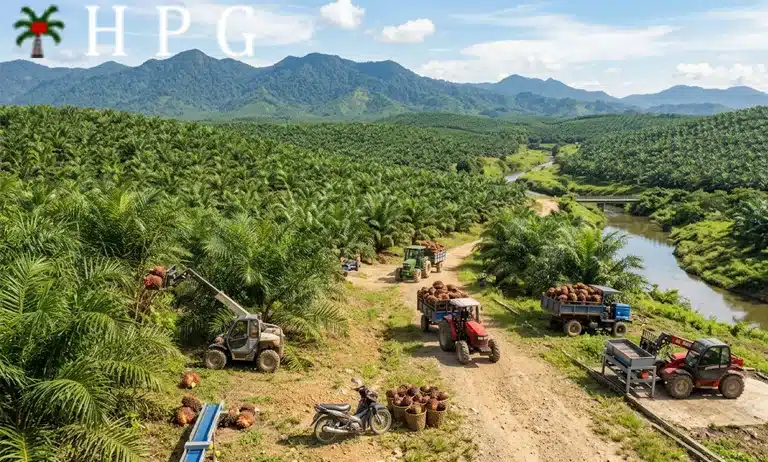
The company’s main operations are located in Buol Regency, Central Sulawesi, covering areas including Bukal, Tiloan, Momunu and Liponoto. The development of the plantation business in Buol represents one of the longest-running chapters in Hardaya’s palm oil operations. According to information reported by IPO NEWS, the group has controlled a substantial area of land associated with its palm oil business in the region.
However, the various figures need to be understood carefully. A reported figure of approximately 51,000 hectares refers to land controlled through the plantation business, while the company’s Hak Guna Usaha (HGU) area and the area actually planted with oil palm are considerably different.
Historical information reported by IPO NEWS indicates that HIP held approximately 22,780 hectares of HGU, while the planted area was around 13,400 hectares, of which approximately 8,398 hectares were mature plantations.
The plantation estates include Mudo, Yugut, Jatimulya, Panilan Jaya and Binuang, demonstrating the scale and geographical spread of the company’s operations in Buol.
From Fresh Fruit Bunches to CPO
Hardaya’s plantation business is not limited to cultivation. The group has also developed processing capabilities to support its upstream plantation operations. Historical production data reported to IPO NEWS indicated an initial production capacity of approximately 156,200 tonnes of fresh fruit bunches (FFB) per year, with CPO production capacity of around 36,200 tonnes per year and palm kernel production of approximately 8,233 tonnes per year.
The integration of plantation activities with palm oil processing provides an important operational advantage. By combining plantation management, harvesting and processing, the group can build a more integrated palm oil value chain.
PT Hardaya Inti Plantations has also obtained ISPO certification, reflecting its participation in Indonesia’s palm oil sustainability framework.
Expanding the Footprint to North Kalimantan
Beyond Central Sulawesi, Hardaya Plantation has also developed a palm oil presence in North Kalimantan, particularly in Nunukan Regency. Two companies associated with the group’s plantation activities in the area are PT Sebakis Inti Lestari (SIL) and PT Sebuku Inti Plantation (SIP).
Operational data from 2022 indicated that the two companies together managed approximately 10,478 hectares, consisting of about 6,477 hectares under SIL and 4,002 hectares under SIP. At that time, approximately 10,414 hectares were reported as mature plantation areas. FFB production from the two operations reached approximately 99,426 tonnes through August 2022.
Although these figures are historical and should not be interpreted as the group’s current total plantation area, they provide an indication of the scale of Hardaya’s plantation operations in North Kalimantan.
More recent developments also indicate that the plantation business remains operational. In April 2026, Hardaya Plantation Group was still recruiting plantation personnel for operations in Nunukan, providing a current indication of the group’s continuing presence in the region.
A Long Term Plantation Business
The development of Hardaya Plantation illustrates how a major Indonesian private business group has built a plantation footprint across two strategically important regions. Central Sulawesi provides the historical foundation of the group’s palm oil business, while North Kalimantan represents an additional area of plantation development.
This geographical diversification is strategically important. Indonesia’s palm oil industry has expanded beyond traditional plantation centers in Sumatra and Kalimantan, with Sulawesi and other regions becoming increasingly relevant to the national palm oil supply chain.
For Hardaya, the combination of plantation assets, processing facilities and long standing experience gives the group an established position within Indonesia’s private sector palm oil landscape.
Partnership and Community Relations
As with many large plantation businesses in Indonesia, Hardaya’s operations have also involved relationships with surrounding communities and smallholders. Historical reports indicate that PT Hardaya Inti Plantations developed plasma partnerships involving local communities in Buol. By 2011, reports indicated that approximately 1,650 residents were involved through several cooperatives, covering around 4,700 hectares of plasma plantations.
Community partnership remains an important element of Indonesia’s palm oil industry because the sustainability of plantation operations depends not only on production performance but also on constructive relationships with local communities.
At the same time, various reports in recent years have highlighted concerns raised by some farmers regarding plantation partnerships and profit sharing arrangements in Buol. These issues demonstrate the importance of maintaining transparent communication and effective partnership mechanisms between plantation companies and surrounding communities.
Looking Ahead
Hardaya Plantation today represents more than simply a plantation business established decades ago. It is part of the broader legacy of the Central Cipta Murdaya Group and the late Murdaya Poo, whose business interests developed across multiple sectors of the Indonesian economy.
With plantation operations extending from Central Sulawesi to North Kalimantan, Hardaya has built a distinctive geographical footprint in Indonesia’s palm oil industry. For the future, the company’s key opportunities will include improving plantation productivity, strengthening downstream integration, maintaining sustainability standards and continuing to develop constructive partnerships with local communities.
In an industry increasingly driven by productivity, traceability and sustainability, the ability to manage existing plantation assets efficiently will be just as important as expanding the business.
Hardaya Plantation’s journey from Buol in Central Sulawesi to Nunukan in North Kalimantan therefore remains an interesting story to follow in Indonesia’s evolving palm oil industry.
To subscribe or for more information, contact: Marketing Or Email
Need a research report? Please visit CDMI Consulting