
Indonesian Palm Oil News (IPO News) – What Is Replanting?
Replanting is the systematic renewal of ageing oil palm plantations, replacing old palms with new planting material while redesigning fields to secure productivity, efficiency and sustainability for the next 25 years
Why Replanting Is Necessary
- Peak Yield: Declining yield after 19-25 years
- Tall Palms: Difficulty to harvest
- Cost: Higher cost to maintain
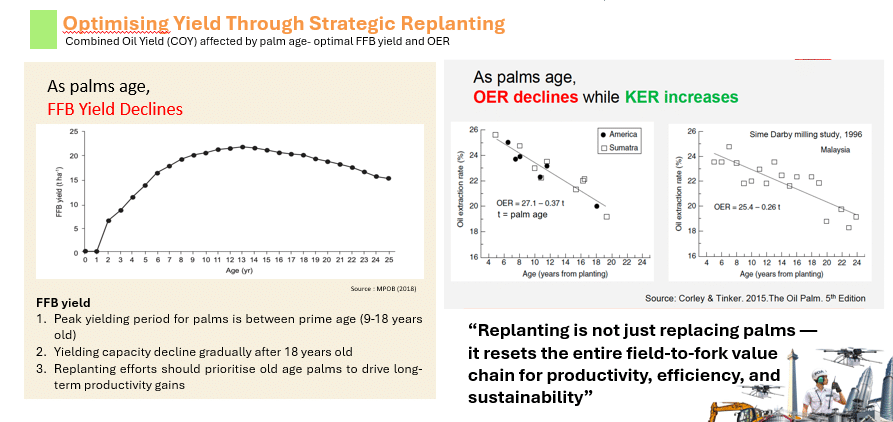
Why Replanting?
- Ageing Tall Palm
- Operational Efficiency
- Declining Yields
- Rising Costs
Why Replanting Needs to Be Mechanisation-Friendly?
Poor Field Layouts are a Structural Barrier to Mechanisation Legacy field designs—irregular block shapes, misaligned terraces, narrow paths and fragmented access—were created for manual systems.
These layouts restrict machine movement and turning radius, increase downtime, crop losses and safety risks
Mechanisation is not a machine problem — it is a field design problem!
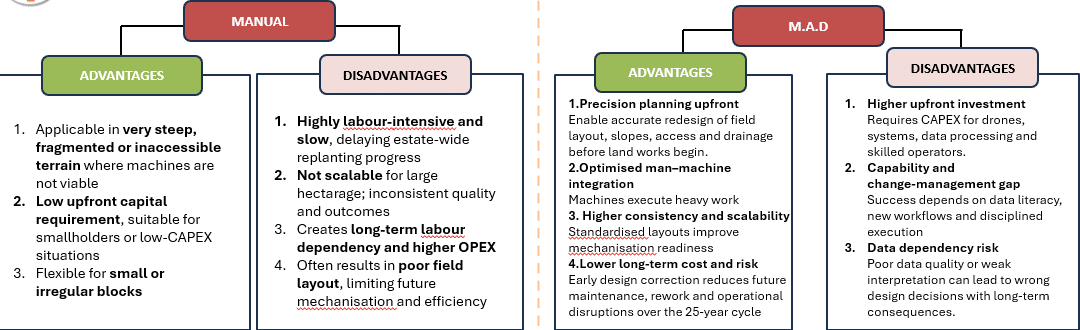
From Manual to Mechanisation. Automation. Digitalization (M.A.D)
Oil palm replanting has options from manual land preparation to M.A.D, data-driven planning, allowing estates to redesign field layout, slopes and drainage upfront. This integration of man and machine optimises resources, reduces labour dependency and locks in long-term operational and cost efficiency for the next production cycle
Digitalisation: Virtual Replanting Blueprint
VRB is a comprehensive digital mapping and planning platform engineered to transform replanting operations to digitised blueprint, maximise SPH, model terracing systems, implement Violle patterns, establish straight planting lines, and coordinate infrastructure development, all before breaking ground.
“Manual replanting repeats past layouts; digitalised replanting redesigns the future”
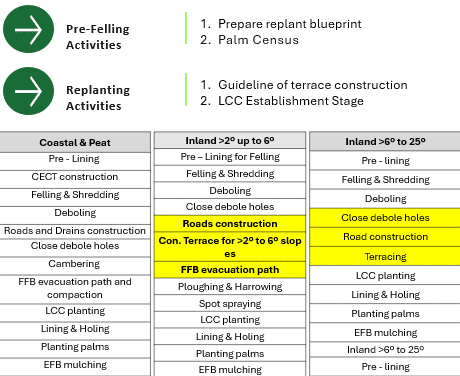
Replanting Technique: Flat & Terrace Area
- Mechanisation Strategy for Flat Terrain (<6°)
1. Straight Lining
2. Grid – Based Road Network
3. Road / Drain / CECTHigh Potential: For Fully Mechanised Harvesting & Non-Harvesting Rollout - Mechanisation Strategy for Undulating Terrain (6° – 12°)
1. Conservation Terrace
2. Straight Planting Rows
3. Cambered Harvesters PathModerate – High Potential:
1. Hybrid mechanised harvesting system
2. Mechanised non harvesting work
3. Controlled soil erosion and soil management - Mechanisation Strategy for Hilly Terrain (12° – 25°)
1. 4-5m contour terrace
2. Diagonal Roads (< 1:8 gradient)
3. Stop Bund & slope protection planControlled Requirement For:
1. Opportunity for Drone Spraying
2. Mechanised non harvesting work, Facilitate crop recovery processes.
3. Focus on accessibility stabilisation/terrace maintenance program - Mechanisation Strategy for VERY STEEP Terrain (>25°)
Not Sustainable - Enabling Mechanisation Through Terrain & Infrastructure Optimisation
– Standardised Terrace Gradient: Clinometer-guided slopes (1:10-1:12) across all terraces to support safe and efficient machine operations
– All Weather Accesibility: Gravelled roads and access paths to ensure continuous operations and minimise downtime
– Improved Machine Mobility: Wider junctions to facilitate smooth equipment movement and reduce operational bottlenecks - How To Do Replanting?
Mechanisation
- Advantages:
– Accelerated Replanting: Enables large-scale and faster replanting
– Reduction of Labour Dependency: Reduces labour dependency
– Better Efficiency: Improves operational efficiency and consistency
– Challenging Terrain: Suitable for challenging terrain and small field blocks - Disadvanteges:
– High Capex Cost: Higher upfront cost for mechanisation
– Safety Concern for Difficult Terrain: Not suitable for steep terrain, peat areas or fragmented fields
– Long Technical Review: Frequent management / technical reviews and input during development process
Replanting is our generational moment to redesign estates for a mechanised future—where growth is driven by intelligence, precision and safety, not land expansion or labour intensity
Conclusion
Mechanisation-led replanting is the key enabler to accelerate replanting, effectiveness & efficiency and sustain long-term productivity in an increasingly labour-constrained and cost-pressured environment.
- Precision Land Preparation: Mechanisation success is determined before planting begins, as machines cannot compensate for poor field design later
- Critical Window Mechanisation Readiness: Field layout, access drainage and spacing must be redesigned upfront, as legacy layouts are the main structural barrier to mechanised operations
- Disciplined Execution: Only estates designed upfront for mechanisation can deliver sustainable productivity, lower costs, and higher labour efficiency
Speaker: Jeffry Faizal Kamaruddin, Chief Executive Officer, Upstream Malaysia, SD Guthrie at HASI 2nd 2026
Untuk berlangganan atau informasi lebih lanjut, hubungi: Marketing atau Email
Butuh Buku Riset? Silahkan kunjugi CDMI Consulting