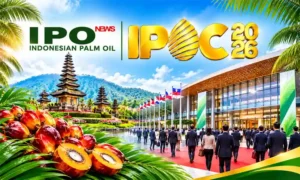

Indonesian Palm Oil News (IPO News), Nusa Dua, Bali – The 22nd Indonesian Palm Oil Conference (IPOC) and 2027 Price Outlook, held on November 11–13, 2026, at the Bali International Convention Center (BICC), The Westin Resort Nusa Dua, Bali, provided important insights into the direction and prospects of Indonesia’s palm oil industry.
The annual conference, organized by the Indonesian Palm Oil Association (GAPKI), brought together government representatives, business leaders, market analysts, academics, and international palm oil industry stakeholders.
Under the theme “Palm Oil in a Fragmented World: Securing Food, Energy, and Economic Resilience,” IPOC 2026 reaffirmed the strategic role of palm oil in meeting global food, energy, and trade requirements.
Optimism about Indonesia’s palm oil industry remains strong. However, several structural challenges must be addressed to ensure that Indonesia maintains its position as the world’s largest palm oil producer.
CPO Supply and Price Outlook for 2027
One of the key topics discussed at IPOC 2026 was the outlook for palm oil supply and prices in 2027. The threat of El Niño could affect plantation productivity in Indonesia and Malaysia, the world’s two leading palm oil-producing countries. Any decline in production could tighten global supplies and provide support for CPO prices.
Meanwhile, growing domestic demand for palm oil as a biodiesel feedstock will also become an important factor influencing the balance between supply and demand.
Indonesia faces the challenge of maintaining a balance between domestic requirements, particularly for energy, and its export interests.
Five Major Challenges Facing Indonesia’s Palm Oil Industry
Among the various issues highlighted at IPOC 2026, five key priorities deserve particular attention from the government and industry stakeholders.
1. Accelerating Smallholder Replanting
Plantation productivity remains a major challenge. The Smallholder Palm Oil Replanting Program (PSR) needs to be accelerated, as many oil palm plantations have reached an advanced age and require replanting.
The availability of high-quality seeds, financing, and technical assistance will be essential to improving smallholder productivity and strengthening national CPO supplies.
2. Ensuring the Sustainability of the Biodiesel Program
The development of biodiesel, including the planned implementation of B50, will increase domestic demand for palm oil.
This policy supports national energy security while expanding the domestic market for CPO. However, feedstock availability and the sustainability of program financing must be carefully considered to avoid disrupting the industry’s overall balance.
3. Providing Legal Certainty over Plantation Land
Legal certainty regarding plantation land status is essential for sustainable investment.
The restructuring of forest areas and the resolution of land legality issues must be carried out transparently and consistently, providing certainty for both plantation companies and smallholders.
4. Strengthening Certification and Sustainability
Strengthening Indonesian Sustainable Palm Oil (ISPO) certification and product traceability systems is becoming increasingly important to maintaining access to international markets.
Indonesia’s palm oil industry must demonstrate that its production meets sustainability standards throughout the supply chain, from plantations to final product distribution.
5. Maintaining Export Competitiveness
Indonesia must maintain its palm oil competitiveness amid growing competition in the global vegetable oil market.
Export levy policies, downstream industry development, and market expansion must be implemented in a balanced manner to ensure that Indonesia remains competitive while generating greater added value from its palm oil industry.
Building a Positive Narrative for Indonesian Palm Oil
Beyond production and trade issues, IPOC 2026 also highlighted the importance of developing a positive narrative about Indonesia’s palm oil industry.
Indonesia needs to communicate more actively the industry’s contributions to economic growth, employment, smallholder welfare, energy security, and regional development.
Higher oil yields per hectare, sustainable plantation practices, and improved product traceability should become integral parts of Indonesia’s global industry narrative.
A Strategic Momentum for 2027
IPOC 2026 provides an important opportunity for all stakeholders to formulate strategic measures in response to the evolving dynamics of the palm oil industry in 2027.
The government, plantation companies, associations, research institutions, and smallholders need to strengthen cooperation in improving productivity, ensuring investment certainty, expanding downstream industries, and maintaining export competitiveness.
The prospects for Indonesia’s palm oil industry remain promising. However, this optimism must be supported by concrete action to ensure that Indonesia not only remains the world’s largest producer but also becomes a leading force in meeting global food and energy needs.
Muslim M. Amin
Editor in Chief
INDONESIAN PALM OIL NEWS (IPO NEWS)
Research-Based Palm Oil Media
To subscribe or for more information, contact: Marketing Or Email
Need a research report? Please visit CDMI Consulting