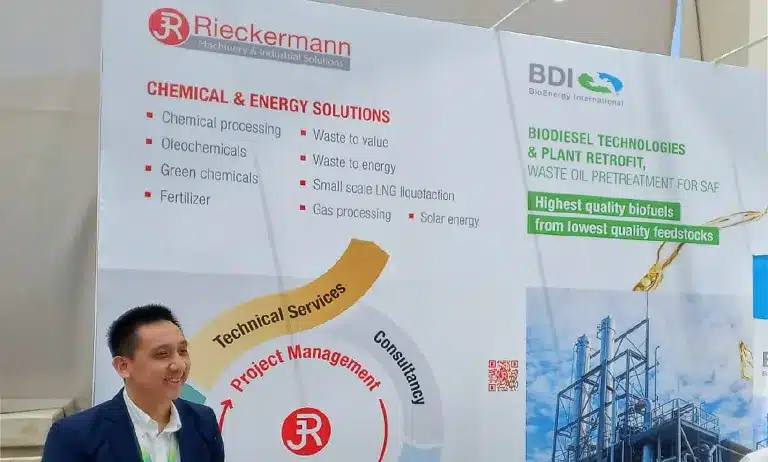
Indonesian Palm Oil News (IPO News), Denpasar – The enormous potential of palm oil mill effluent (POME) in Indonesia is attracting growing attention as a potential feedstock for renewable energy. Recognizing this opportunity, Rieckermann is exploring cooperation with Indonesia’s palm oil industry to develop the utilization of POME, including its potential application in biodiesel production.
The opportunity was highlighted by Bayu Dirgantara, Division Manager Chemical & Energy at Rieckermann, during the 6th Palm Biodiesel Conference in Bali.
According to Bayu, Rieckermann is currently opening discussions with palm oil companies in Indonesia regarding potential cooperation. The company has recently approached one major palm oil group to explore a possible collaboration. However, the discussion is still at an exploratory stage and does not represent an awarded project or confirmed contract.
The identity of the palm oil group remains confidential.
Indonesia’s Huge POME Potential
Rieckermann’s interest in POME is closely linked to the enormous volume generated by Indonesia’s palm oil industry.
A study by Wageningen University & Research (WUR) estimates that Indonesia’s palm oil industry generates nearly 100 million tonnes of POME annually. The figure highlights the enormous scale of POME resources available in Indonesia and the potential to develop them into renewable energy and other value-added products.
This scale also creates opportunities for technology providers to develop solutions that can transform palm oil mill by-products into higher-value resources.
Against this backdrop, Rieckermann sees opportunities to cooperate with palm oil companies of different sizes, depending on their individual needs, resources and project potential.
POME as a Biodiesel Feedstock
One of the opportunities being explored by Rieckermann involves the utilization of POME as a feedstock for biodiesel production.
Rieckermann has a strategic relationship with BDI-BioEnergy International, an Austrian technology company specializing in biodiesel technologies based on a wide range of feedstocks. Its technology portfolio is designed to accommodate various feedstocks, including waste-based and challenging raw materials.
With this technological background, Rieckermann sees Indonesia’s palm oil industry as a market with significant potential for the development of waste-to-energy solutions.
For palm oil companies, utilizing POME to produce value-added products could also support resource efficiency and contribute to a more circular approach to industrial production.
Turning Waste into Value
The enormous volume of POME generated in Indonesia makes technology development increasingly important. Traditionally, POME has primarily been regarded as a liquid waste stream that must be properly managed by palm oil mills.
With the right technology, however, POME can also be viewed as a resource with economic value.
This is the opportunity Rieckermann is currently exploring. Rather than viewing palm oil companies solely as users of industrial machinery and equipment, the company sees them as potential partners in developing technology solutions that can convert industrial by-products into new sources of value.
Bayu emphasized that cooperation opportunities remain open and are not limited to any particular category of palm oil company.
Given Indonesia’s enormous POME resources, there is considerable room for the development of renewable energy and other value-added applications. The key challenge is turning this resource potential into projects that are technically feasible and economically viable.
Rieckermann Expands Its Engagement
Rieckermann’s approach to Indonesia’s palm oil industry reflects its interest in the long-term potential of the sector.
With experience in industrial technology, engineering, machinery, project management, commissioning and technical services, Rieckermann can potentially serve as a technology partner for companies seeking to develop POME utilization projects.
For Indonesia’s palm oil industry, such technologies could provide additional opportunities to optimize the utilization of by-products generated throughout the production process.
With POME generation estimated at nearly 100 million tonnes annually, the potential market for technology and investment remains substantial.
Rieckermann is now beginning to explore this opportunity with Indonesia’s palm oil industry. Whether the country’s vast POME resources can eventually be developed into commercial-scale biodiesel and renewable-energy projects will depend on technological readiness, economic feasibility and the investment decisions of individual palm oil companies.
To subscribe or for more information, contact: Marketing Or Email
Need a research report? Please visit CDMI Consulting